Looksmaxxing Guide: A Safer, Evidence-Aware Approach to Appearance
Looksmaxxing is the online term for trying to maximize physical appearance. The broad idea includes ordinary grooming and health habits, but some communities combine those with rigid rankings, pseudoscientific measurements, dangerous substances, self-injury and the belief that appearance determines human worth. A responsible guide separates low-risk self-care from high-risk behavior.
The safest version of looksmaxxing is ordinary self-care with realistic expectations. It does not require a PSL target, a perfect facial ratio or the idea that one narrow beauty standard controls social value.
Published 2026-08-06 · Last reviewed 2026-08-06
What does looksmaxxing mean?
The term developed in online appearance and manosphere communities and later spread through TikTok, YouTube, forums and mainstream media. Users often divide practices into “softmaxxing,” meaning lower-risk or noninvasive changes, and “hardmaxxing,” meaning invasive, extreme or permanent changes.
Those labels are not reliable safety classifications. A practice called soft may still become harmful when it involves restrictive dieting, unregulated supplements, obsessive tracking or untreated mental-health distress.
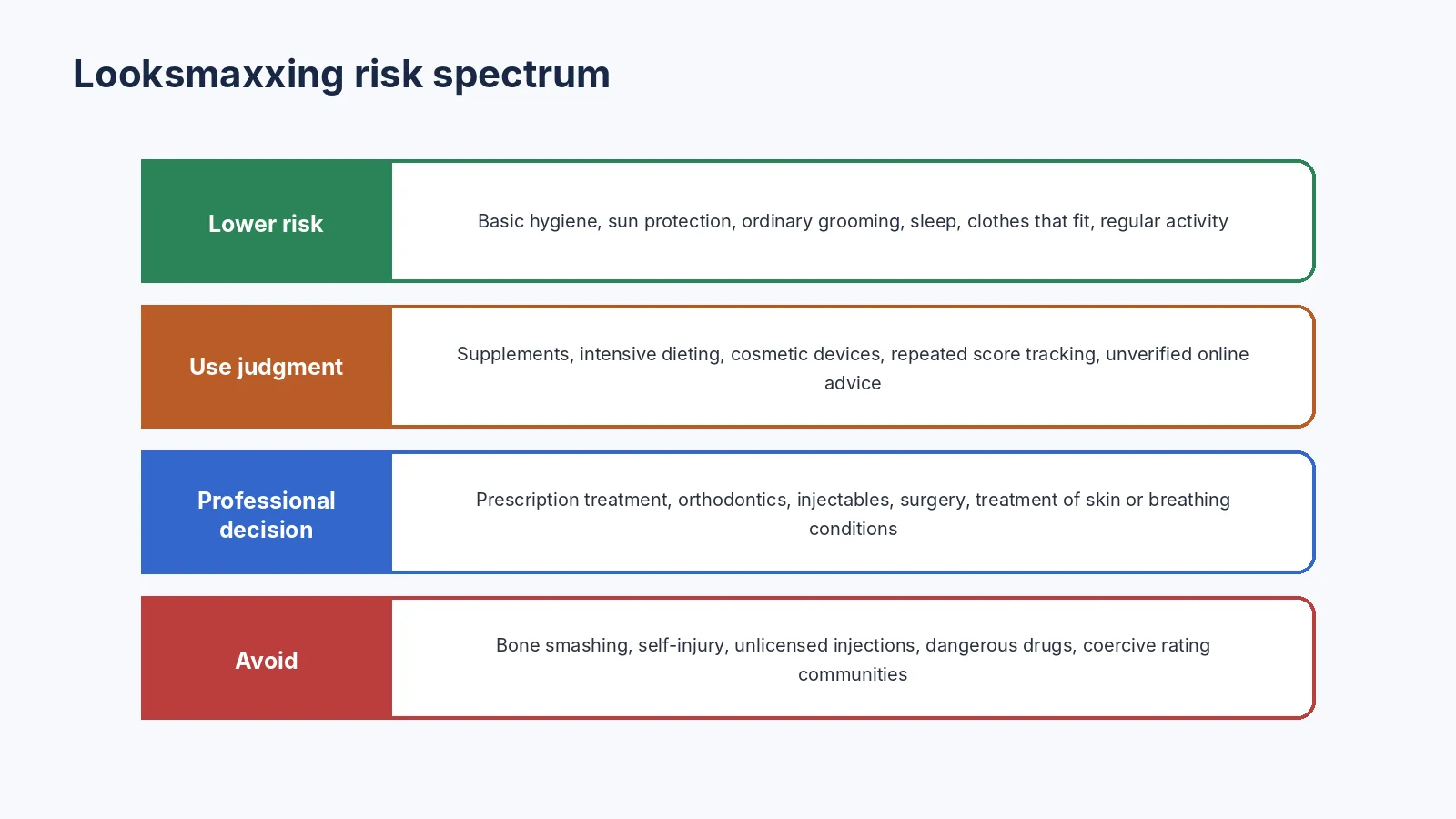
A practical risk spectrum
| Level | Examples | Rule |
|---|---|---|
| Lower risk | Basic hygiene, ordinary grooming, clothes that fit, sun protection, sleep and regular activity. | Use for health and self-expression, not punishment. |
| Needs judgment | Intensive diets, supplements, devices, repeated scoring and unverified routines. | Check evidence, cost, side effects and compulsive use. |
| Professional decision | Prescription treatments, orthodontics, injectables, surgery and treatment of medical conditions. | Use properly licensed professionals and informed consent. |
| Avoid | Bone smashing, self-injury, unlicensed injections, dangerous drugs, crash dieting and coercive rating communities. | Do not normalize or provide instructions. |
Low-risk foundations
Grooming and personal style
Hair, facial hair, clothing, eyewear and eyebrow grooming can affect presentation. There is no universal style that fits every face or identity. The useful goal is intentional self-presentation, not conformity to a single influencer template.
Skin and dental health
Basic cleansing, moisturizer when needed, sun protection and routine dental care are reasonable. Persistent acne, skin disease, dental pain or bite problems require appropriate professional care rather than increasingly aggressive online hacks.
Sleep, movement and nutrition
Ordinary health habits support energy and wellbeing. Avoid exact body-fat targets, crash diets or claims that one diet creates a particular face. A healthcare or nutrition professional can individualize goals when necessary.
Photography and presentation
Lighting, camera distance, posture and expression can change how a face appears online. Learning photography is safer and more honest than claiming a new image proves bone growth.
Common claims that exceed the evidence
- Mewing will reshape the adult maxilla and jaw.
- Chewing hard objects creates an ideal gonial angle.
- Eyelid pulling or squinting creates hunter eyes.
- One golden-ratio mask defines objective beauty.
- A PSL score maps to an exact population percentile.
- One supplement or hormone protocol is safe for anyone seeking a more masculine or feminine face.
- Cosmetic procedures guarantee confidence, relationships or status.
Professional treatments are not internet challenges
Orthodontics, dermatology, prescription medication and cosmetic procedures can be appropriate for selected people after evaluation. They also have costs, limitations and risks. A responsible article never diagnoses a user from a selfie or suggests a procedure because an entertainment score is low.
Why repeated face scoring can backfire
The score varies with the photograph, which can encourage endless attempts to find a more favorable result. This resembles body checking: repeatedly examining appearance to see whether it has changed. Cleveland Clinic notes that body checking can become compulsive, while NHS guidance lists repeated comparison and mirror checking or avoidance among possible BDD symptoms.
Set limits: do not test daily, do not compare yourself with edited strangers and do not allow a score to decide whether you attend social events.
Social-media literacy
- Assume that lighting, editing, procedures or sponsorship may be undisclosed.
- Check whether the source is qualified for medical or dental claims.
- Look for the exact study rather than a screenshot of a statistic.
- Ask whether the advice applies to the user’s age and health.
- Notice whether the creator profits from fear or a narrow standard.
- Leave communities that encourage humiliation, racism, misogyny or self-harm.
A safer personal plan
Choose goals that improve daily life even if no one sees a before-and-after photograph: comfortable dental care, skin symptoms under control, clothing you enjoy, adequate sleep, enjoyable movement and social confidence built through activities and relationships.
Track function and wellbeing, not only appearance. If a routine causes pain, financial strain, secrecy, shame or social withdrawal, it is not a successful improvement plan.
When to get help
Seek professional support when appearance worry takes hours, causes school or work problems, leads to avoidance, drives dangerous dieting or substance use, or creates thoughts of self-harm. BDD is treatable and does not mean someone is vain.
Frequently asked questions
What is softmaxxing?
What is hardmaxxing?
Is looksmaxxing only for men?
Can looksmaxxing improve confidence?
Are AI face scores useful for progress?
When should I stop?
References
- [1] Looksmaxxing: What It Is and Why It Can Be Harmful — Cleveland Clinic — Current clinical overview and risk discussion, published July 2026.
- [2] Body dysmorphic disorder — NHS — Authoritative symptoms and treatment overview.
- [3] What Is Body Checking and How To Stop — Cleveland Clinic — Explains ordinary and compulsive appearance checking.
- [4] Does Mewing Actually Reshape Your Jaw? — AAO — Evidence boundary for a common looksmaxxing claim.
- [5] TMD — NIDCR — Clinical boundary for jaw pain and excessive chewing.