Does Mewing Work? What Orthodontic Evidence Says
Mewing is an online practice that usually involves holding the tongue against the roof of the mouth with the lips closed, often with claims that it can create a sharper jawline, move the maxilla, straighten teeth or reshape the face. Current professional orthodontic guidance does not support those cosmetic reshaping claims.
Published 2026-08-06 · Last reviewed 2026-08-06
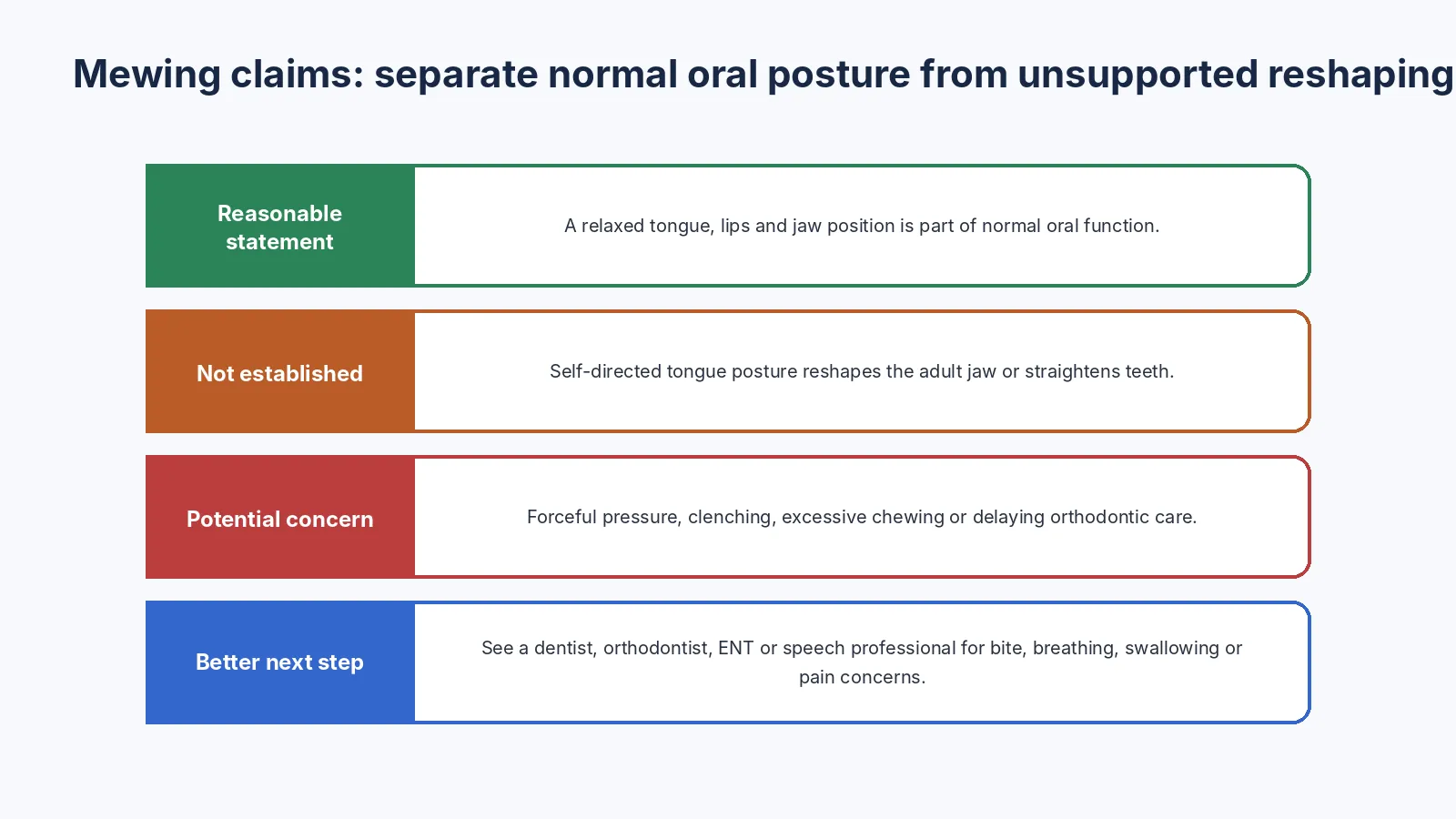
Where did mewing come from?
The term is associated with ideas promoted by British orthodontists John and Mike Mew and later spread through social media and looksmaxxing communities. Online versions vary: some describe relaxed tongue rest, while others encourage forceful pressure, prolonged clenching or elaborate exercises.
Those differences matter. A neutral description of oral posture is not the same as a claim that adults can remodel facial bones through constant pressure.
What supporters claim
- A sharper or wider jawline.
- Forward growth of the upper jaw.
- Straighter teeth or a corrected bite.
- Improved breathing or swallowing.
- Changes around the eyes and cheekbones.
- Prevention of orthodontic treatment.
A website should not repeat these claims as established benefits. Each would require clinical evidence for the relevant age group, technique, duration and outcome.
What orthodontic organizations say
In March 2025, the American Association of Orthodontists stated that scientific evidence supporting jawline-sculpting claims is lacking and that tongue placement alone cannot correct misaligned teeth or reshape the jaw. It also warns of possible bite, tooth and speech problems from improper pressure.
In May 2025, the British Orthodontic Society reiterated that there is no scientific evidence that patients can change face shape by chewing, holding the teeth and tongue in a closed position or making facial movements.
Normal tongue posture versus forceful mewing
| Normal functional concept | Unsupported or risky interpretation |
|---|---|
| The tongue has a resting position and helps with speech and swallowing. | Press as hard as possible all day to remodel bone. |
| Lips and jaw may rest comfortably without clenching. | Keep the teeth forcefully together. |
| Breathing or swallowing problems deserve assessment. | Self-diagnose airway or jaw growth from selfies. |
| Children’s growth can be influenced by diagnosed conditions and clinical treatment. | Adults can reproduce clinical orthopedic treatment with an online routine. |
Why adult bone remodeling is not simple
Orthodontic tooth movement and jaw treatment use controlled forces, diagnosis, monitoring and biological principles. Some growth-guidance approaches are age- and condition-specific. The fact that professional treatment can move teeth or influence development does not prove that unsupervised tongue pressure can create a chosen adult face.
Potential risks
- Tooth movement or bite changes from abnormal force.
- Jaw-muscle fatigue, clenching or temporomandibular symptoms.
- Speech or swallowing difficulty from unnatural posture.
- Delayed diagnosis of bite, airway or dental problems.
- Compulsive monitoring and unrealistic expectations.
The NIDCR advises people with temporomandibular disorders to reduce habits such as clenching and gum chewing. Pain, locking, restricted movement or bite change should not be treated by increasing pressure.
Does mewing help children?
Children’s craniofacial development, mouth breathing, enlarged tonsils, tongue function and bite problems are complex. A parent should not diagnose a child from social-media photographs or start a forceful routine. Pediatric dental, orthodontic, medical, ENT or speech evaluation may be appropriate depending on symptoms.
What about breathing?
Nasal breathing is important, but a person may mouth-breathe because of congestion, allergies, anatomy, sleep-disordered breathing or another condition. Telling someone simply to keep the mouth closed can be unsafe if the underlying cause is not understood.
Can mewing change a face-rating score?
Temporarily changing head posture, jaw tension or tongue position may alter a photograph and therefore an image score. That does not demonstrate skeletal remodeling. A result should not be used as proof that the method worked.
Safer next steps
- Do not use force or clench the teeth.
- Stop any routine that causes pain, speech difficulty or bite change.
- See a dentist or orthodontist for tooth or bite concerns.
- See a healthcare or ENT professional for persistent breathing problems.
- Use a speech-language or other qualified professional when swallowing or tongue function is a concern.
- Avoid daily appearance-score tracking as a substitute for clinical outcomes.
This article should not contain a step-by-step “correct mewing” routine. The existing /how-to-mew-correctly URL should permanently redirect here.
Frequently asked questions
Does mewing reshape your jaw?
Can mewing straighten teeth?
How long does mewing take?
Should my teeth touch while mewing?
Can mewing fix mouth breathing?
Why do before-and-after photos look different?
References
- [1] Does Mewing Actually Reshape Your Jaw? — American Association of Orthodontists — Primary professional guidance updated in 2025.
- [2] British Orthodontic Society statement on mewing — Professional statement that evidence does not support face-shape changes.
- [3] TMD — National Institute of Dental and Craniofacial Research — Authoritative jaw symptoms and conservative-care guidance.
- [4] Risks of Mewing — AAO PDF — Concise risk summary from the orthodontic association.