Mogging Explained: Meaning, Origin, and How the Slang Is Used Online
To “mog” someone means to outclass, overshadow or dominate them. In current social-media slang, it often means looking noticeably taller, more muscular, better dressed or more conventionally attractive beside another person. “Mogging” can be used jokingly, but it can also turn people into a competitive appearance hierarchy.
Example: “He height-mogged everyone in the photo” means the speaker thought he looked much taller than the others. It is not a scientific judgment or a permanent social category.
Published 2026-08-06 · Last reviewed 2026-08-06
Where the word came from
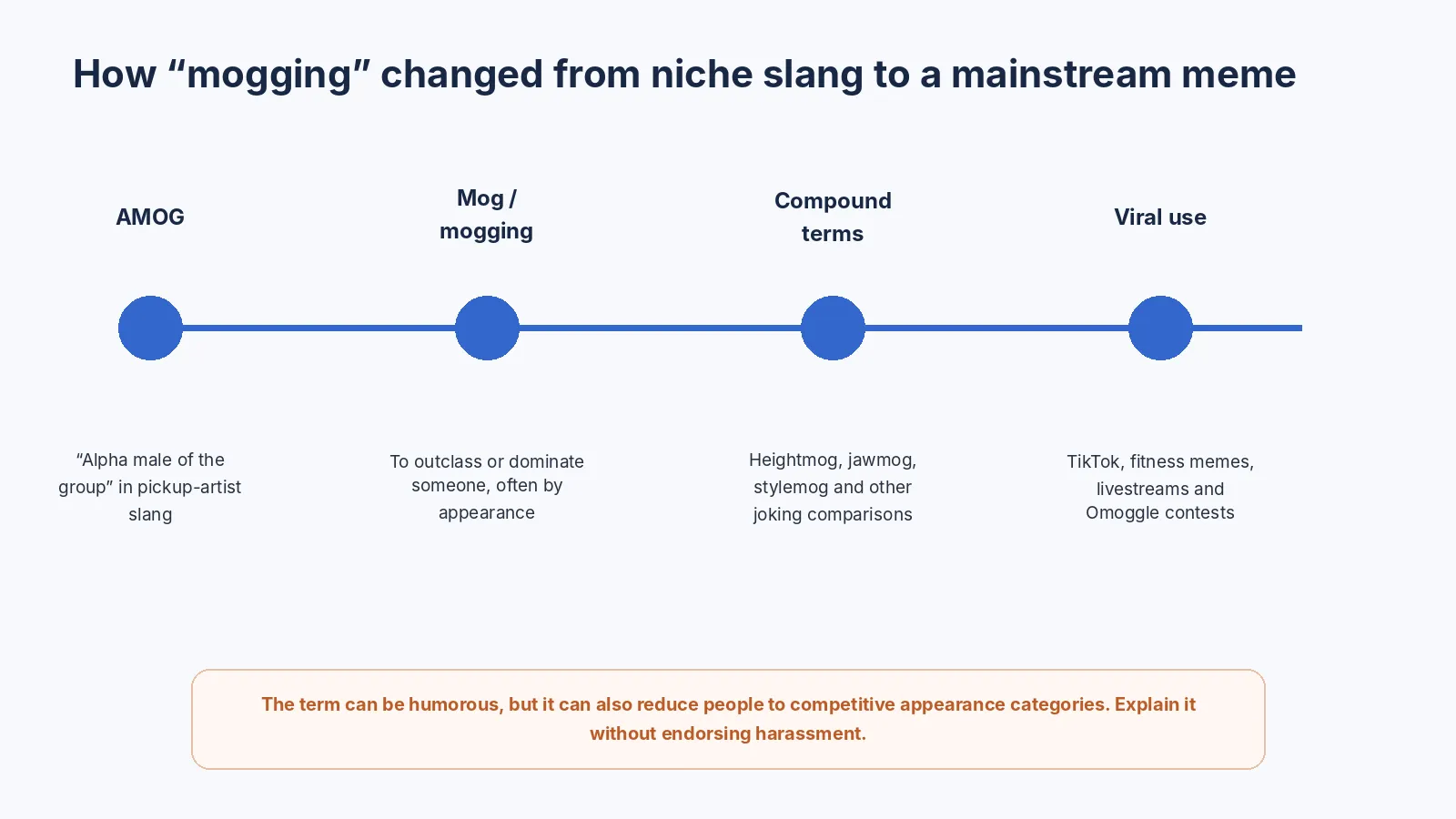
The modern slang is commonly connected with “AMOG,” short for “alpha male of the group,” a term used in pickup-artist and manosphere spaces. “Mog” then became a verb for dominating or outclassing someone. Appearance and looksmaxxing communities expanded it into many compounds.
Internet slang rarely has one clean origin date. Explain the commonly documented route without claiming that one forum or user definitively invented every modern usage.
Common forms of the word
| Term | Typical online meaning |
|---|---|
| Mog | To outclass or overshadow. |
| Mogged | Past tense: someone was perceived as outclassed. |
| Mogging | The act or situation of outclassing. |
| Heightmog | To appear much taller than someone. |
| Jawmog | To be perceived as having a stronger jawline. |
| Stylemog | To stand out through clothing or styling. |
| Facemog | To be judged as having a more attractive face. |
How the term spread
Mogging vocabulary moved from niche forums into fitness memes, TikTok edits, celebrity comparisons, livestream chat and face-rating content. In 2026, media coverage connected the term with Omoggle, a live 1v1 appearance contest that used face metrics and an Elo-like ranking system.
Mogging versus looksmaxxing
Looksmaxxing describes attempts to improve appearance. Mogging describes comparison or dominance. A user may looksmax in order to avoid being “mogged,” but the words are not synonyms.
Is mogging serious or a joke?
It depends on context. Friends may use it as exaggerated meme language. In other settings it becomes harassment, public humiliation, racism, misogyny or bullying. The humorous tone does not erase the impact on the person being ranked.
Why the framework is misleading
- It reduces a complex person to one visible comparison.
- Photos and videos are affected by height position, lens, pose and editing.
- Preferences differ between people and cultures.
- A viral clip does not establish real-world status or worth.
- Constant comparison can reinforce body checking and insecurity.
Mogging in photographs
A taller person nearer the camera can look dramatically larger. Wide-angle lenses exaggerate distance from the center. Lighting and posture can sharpen one person’s features. A “mog” image may therefore be staged or photographically distorted.
Live mog battles
A live platform can add random matching, webcam exposure, algorithmic scoring and public rankings. Users should check age rules, moderation, recording, account data, camera permissions and privacy policies. Omogle.net is a separate single-user browser tool and does not operate those live stranger matches.
How to use the word responsibly
- Do not apply the label to a person who has not agreed to be rated.
- Avoid racial, gendered or dehumanizing tier language.
- Do not post strangers’ images for group scoring.
- Treat the term as slang rather than fact.
- Leave competitive appearance spaces if they harm confidence or behavior.
Frequently asked questions
What does mogging mean?
What does “mogged” mean?
What is AMOG?
Is mogging the same as looksmaxxing?
What is a mog battle?
Is mogging scientific?
References
- [1] Mogging — Know Your Meme — Use as an internet-culture chronology and example archive, not a scientific source.
- [2] Inside the PSL Scale — GQ — Context for looksmaxxing language and hierarchy.
- [3] Streaming platform Twitch lets users enter viral “mogging” beauty contests — The Guardian — Current reporting on live Omoggle contests and culture.
- [4] Looksmaxxing: What It Is and Why It Can Be Harmful — Cleveland Clinic — Health and wellbeing context for appearance comparison.