How to Improve a PSL-Style Score Safely and Realistically
The safest way to improve a PSL-style result is usually to improve the photograph and ordinary presentation, not to chase a permanent number. Better lighting, a neutral camera position, basic grooming and a clear image can change how a landmark tool reads the face. Claims that exercises can rapidly remodel adult facial bones are not supported.
A higher tool score may reflect a better photograph rather than a physical change. Decide whether your goal is a more reliable test, a better-looking photo, healthier self-care or treatment of a real health concern. Each goal needs a different approach.
Published 2026-08-06 · Last reviewed 2026-08-06
First decide what “improve” means
| Goal | Appropriate action |
|---|---|
| More reliable AI result | Standardize the photo, lighting, pose and file. |
| Look better in photos | Improve lighting, camera distance, expression, grooming and styling. |
| General wellbeing | Use sustainable sleep, movement, nutrition, dental and skin care. |
| Bite, breathing, pain or skin condition | Seek assessment from an appropriate licensed professional. |
| Change bone structure | Do not rely on social-media exercises or self-injury; clinical options require individualized professional evaluation. |
Improve the photograph before interpreting the face
AI face ratings are highly photo-dependent. Use eye-level framing, even light and a lens distance that avoids an extreme close-up. Keep the head straight and the expression relaxed. Remove filters and avoid artificially pushing the jaw forward or squinting.
A good baseline photograph is not necessarily the most flattering photograph. It is the one that makes repeat comparisons less noisy.
Low-risk appearance fundamentals
Grooming and styling
A haircut that suits your hair texture, maintained facial hair, clean clothing and an intentional eyebrow shape can change visual framing without claiming to change anatomy. These are personal style choices, not universal rules.
Skin protection and basic care
Use gentle cleansing, moisturizer when needed and sun protection appropriate to your skin and local guidance. Persistent acne, rash, scarring or irritation belongs with a qualified healthcare professional rather than a face-score article.
Dental care
Routine oral hygiene and professional dental care can improve health and smile confidence. Bite problems, crowded teeth and jaw discomfort require a dentist or orthodontist; they cannot be responsibly diagnosed from an entertainment score.
Sleep and ordinary health habits
Poor sleep, dehydration, illness and alcohol may change how someone looks in a particular morning photograph. General healthy habits can support wellbeing and presentation, but the site should not prescribe exact diets, body-fat targets or supplement plans.
What cannot be promised
- Tongue posture does not have established evidence for sculpting an adult jawline.
- Chewing hard gum or using jaw trainers does not selectively create an ideal facial shape and may aggravate jaw symptoms.
- Squinting or eyelid pulling does not remodel the adult eye socket.
- Face exercises do not selectively burn facial fat.
- One golden-ratio mask does not define universal beauty.
- A score improvement does not predict dating, career or social outcomes.
Mewing, chewing and jaw exercises
The American Association of Orthodontists states that scientific evidence does not support mewing claims that tongue placement reshapes the jaw or corrects teeth. The British Orthodontic Society likewise states that there is no scientific evidence that chewing, closed-position tongue habits or facial movements change face shape.
Forceful pressure, prolonged clenching and excessive gum chewing can create discomfort or worsen jaw-joint and muscle symptoms. NIDCR advises people with temporomandibular disorders to reduce habits such as clenching and gum chewing.
Weight and facial appearance
Overall body-weight change may affect facial volume, but there is no reliable way to choose where fat is lost first. Rapid or unnecessary weight loss can create unwanted volume loss and health risks. This website should never tell a user to diet because of a face score.
A rounder-looking face may also reflect temporary puffiness, anatomy, age, medication or a health issue. Sudden, one-sided, painful or persistent swelling requires professional assessment.
When professional care is appropriate
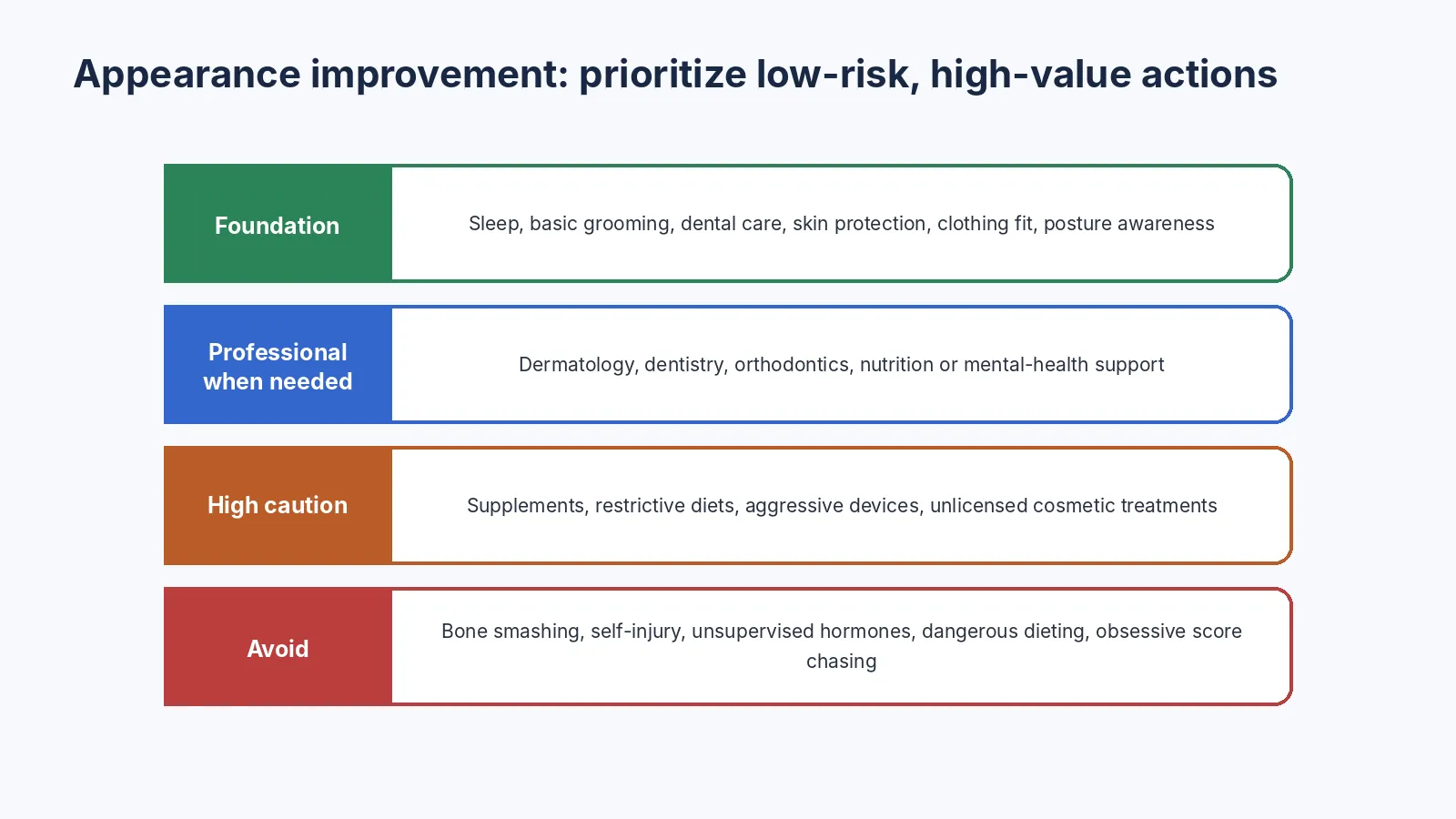
- A dermatologist for persistent skin disease or scarring.
- A dentist or orthodontist for bite, tooth alignment or jaw-development concerns.
- An ENT or other clinician for breathing or swallowing problems.
- A healthcare professional for unexplained swelling or rapid weight changes.
- A mental-health professional when appearance worry or checking interferes with daily life.
Build a score-neutral progress system
If you want to track grooming or photographic presentation, do not make the AI score the only outcome. Record whether the photo setup was consistent, whether your routine is comfortable and sustainable, and whether you feel better in everyday life.
- Use one baseline photo protocol rather than dozens of spontaneous selfies.
- Change only one presentation variable at a time.
- Wait long enough to evaluate ordinary habits without compulsive daily checking.
- Keep health goals separate from attractiveness scores.
- Set a limit on how often you use rating tools.
Red flags to avoid
Do not promote bone smashing, forceful eyelid manipulation, dangerous dieting, unsupervised hormones, research chemicals, unlicensed injections, tooth filing or delaying necessary clinical care.
A lower score does not mean something is medically wrong. If an online community tells you that one feature makes you unworthy, the problem is the ranking culture, not the feature.
Frequently asked questions
Can lighting improve my PSL score?
Do jaw exercises improve the score?
Can weight loss improve a face score?
Does skincare change facial geometry?
Should I compare daily scores?
What if I have jaw pain or bite problems?
References
- [1] Does Mewing Actually Reshape Your Jaw? — American Association of Orthodontists — Authoritative orthodontic review of unsupported reshaping claims and potential risks.
- [2] British Orthodontic Society statement on mewing — States no scientific evidence that chewing or facial movements change face shape.
- [3] TMD — National Institute of Dental and Craniofacial Research — Symptoms and conservative advice, including reducing clenching and gum chewing.
- [4] Looksmaxxing: What It Is and Why It Can Be Harmful — Cleveland Clinic — Current clinical commentary on lower- and higher-risk behavior and mental-health effects.
- [5] Body dysmorphic disorder — NHS — Authoritative signs and help guidance for appearance preoccupation.