How to Get “Hunter Eyes”? What Can Change and What Cannot
“Hunter eyes” is internet slang for an eye-area look often described as deep-set, horizontally narrow, hooded or supported by a prominent brow region, sometimes with positive canthal tilt. It is not a medical diagnosis or standardized anatomical category. Much of the look depends on skeletal and eyelid anatomy that exercises cannot remodel in an adult.
You can change photography, expression, eyebrows, hair and makeup. You cannot safely exercise an adult eye socket into a different shape.
Published 2026-08-06 · Last reviewed 2026-08-06
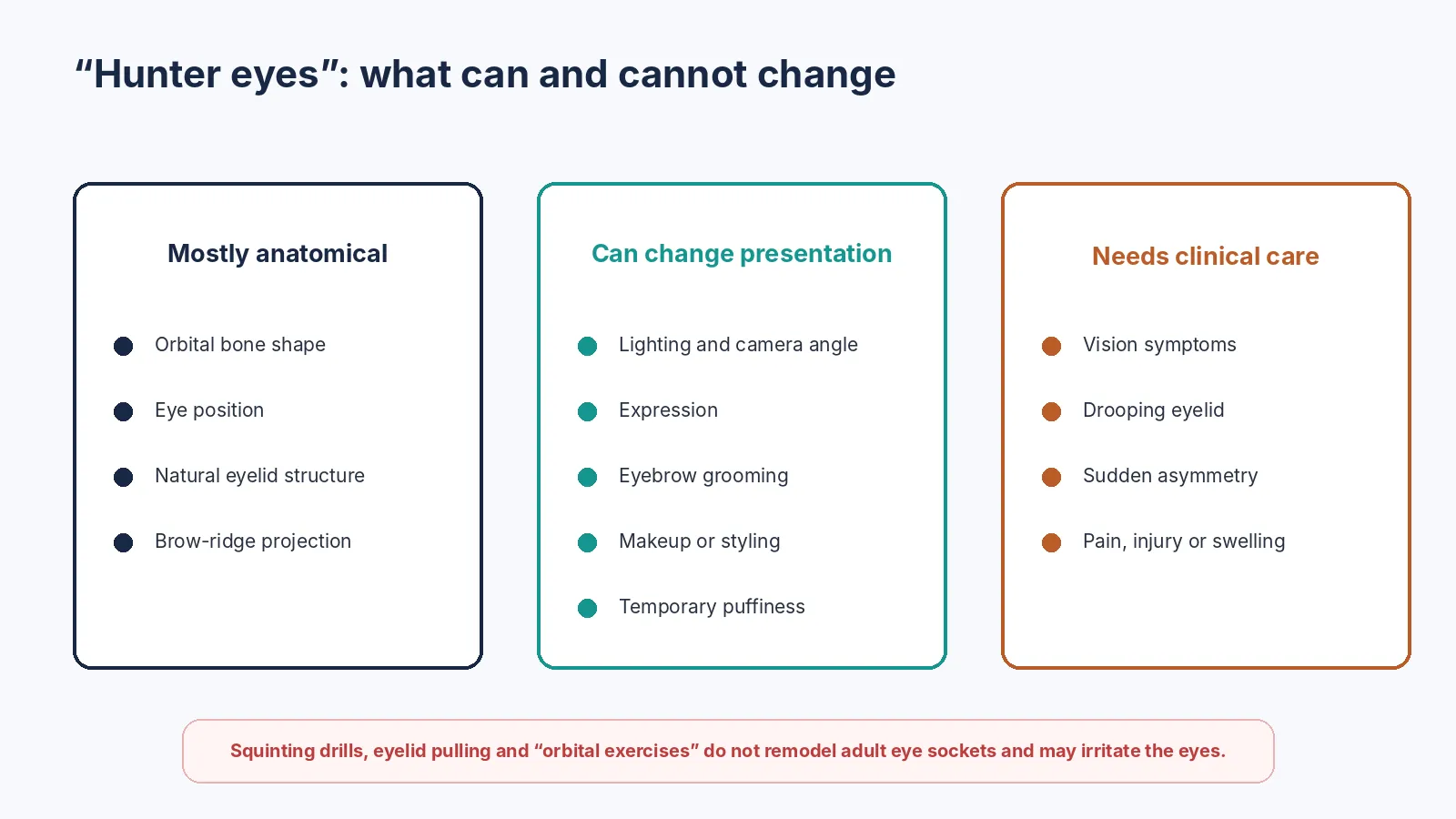
What people usually mean by hunter eyes
Online examples often combine several traits: less visible upper eyelid, a strong brow frame, a relatively narrow eyelid opening, low scleral show and an upward or level outer eye corner. Different communities use the label inconsistently, and edited celebrity images are common.
The opposite label, “prey eyes,” is also informal and frequently used to insult normal variation. Neither label has clinical standing.
Which parts are mostly anatomical?
- Orbital bone shape and depth.
- Natural eyelid and canthal support.
- Eye position relative to the surrounding orbit.
- Brow-ridge and forehead structure.
- Genetic soft-tissue distribution.
- Age-related eyelid and brow changes.
What can change the presentation?
Camera position and lighting
A camera slightly above or below eye level changes the visible brow and eyelid. Side or overhead light can deepen shadows and make the eyes appear more set back. These are image effects.
Expression
A mild natural squint changes the eyelid opening, but deliberately holding a hard squint for long periods is unnecessary and may cause strain or irritation. A relaxed confident expression generally photographs better than forced tension.
Eyebrow grooming and styling
The brow line frames the eyes. Grooming, hairstyle, glasses and makeup may change perception without pretending to alter anatomy. Recommendations should remain inclusive and optional.
Temporary puffiness
Sleep, allergies, irritation and fluid changes may alter the eye area. Persistent or sudden swelling needs appropriate medical assessment rather than an aesthetic exercise routine.
Do hunter-eyes exercises work?
There is no credible evidence that eyelid pulling, repeated hard squinting, “orbital exercises” or pressing around the eyes changes adult orbital bone. The eye area is delicate. Manipulation can irritate skin and eyes, while forceful routines may delay evaluation of real symptoms.
Does mewing create hunter eyes?
Claims that tongue posture moves the adult maxilla enough to change orbital support are not supported by orthodontic evidence. Normal oral posture should not be sold as a do-it-yourself craniofacial remodeling treatment.
Canthal tilt is only one component
Canthal tilt describes the apparent line between the inner and outer eye corners. A positive tilt may be part of some internet examples, but one angle does not create the whole look or determine attractiveness. Photo tilt and landmark placement can also change the estimate.
When to seek eye care
Contact an eye-care or healthcare professional for new eyelid drooping, double vision, visual loss, pain, injury, marked swelling, unequal pupils or sudden facial asymmetry. These are not issues for a face-rating tool.
| Common online goal | Safer interpretation |
|---|---|
| More deep-set look | Use lighting and styling; do not press or injure the eyes. |
| More positive tilt | Understand photo pose; exercises do not remodel the orbit. |
| Less upper-eyelid exposure | Makeup or styling may alter presentation; new drooping needs assessment. |
| Less puffiness | Address ordinary triggers; persistent or sudden swelling needs care. |
How Omogle should discuss the eye area
Omogle may describe detected eye-corner geometry if that measurement is in the current code. It should not label users as predator or prey, diagnose eyelid conditions or promise that a score can be improved through eye exercises.
Frequently asked questions
What are hunter eyes?
Are hunter eyes a medical term?
Can squinting create hunter eyes?
Can mewing change the eye socket?
Can makeup or eyebrows change the look?
What eye changes need care?
References
- [1] Is medial canthal tilt a powerful cue for facial attractiveness? — Specific eye-inclination preference study; not evidence for exercises or a universal ideal.
- [2] Does Mewing Actually Reshape Your Jaw? — AAO — Professional evidence boundary for adult bone-remodeling claims.
- [3] British Orthodontic Society statement — No evidence that facial movements change face shape.
- [4] Omogle Methodology — Product-specific eye-landmark definition and weighting.