Face Symmetry Test: What It Measures, What It Misses, and Why Results Change
A face symmetry test compares selected points on the left and right sides of a photograph. It may detect differences in eye position, mouth corners, jaw contour or distances from an estimated midline. It does not prove that one side of the real three-dimensional face is abnormal, and it cannot diagnose a medical condition.
Mild facial asymmetry is common and biologically normal. The practical question is not whether a face is a perfect mirror image, but whether a measurement is reliable, whether the difference affects function and whether there has been a sudden change.
Published 2026-08-06 · Last reviewed 2026-08-06
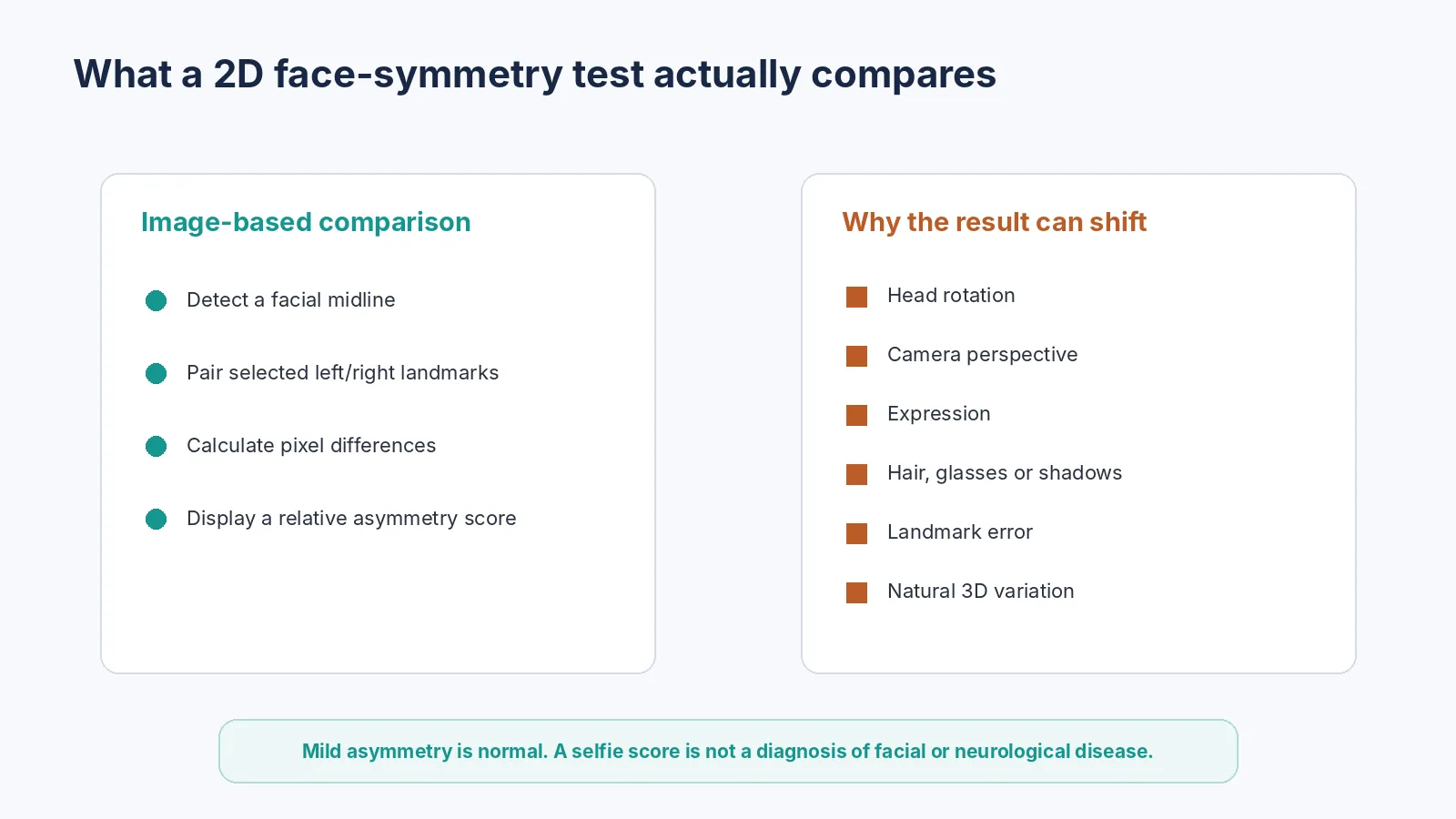
How an image-based symmetry test works
- The software detects a face in the photograph.
- It estimates a facial centerline or uses central landmarks.
- It pairs selected left and right landmark points.
- It compares pixel distances, angles or relative positions.
- It converts those differences into a score or visual overlay.
The output is a comparison inside the image. It is not the same as a clinical three-dimensional assessment using examination, photographs, dental records or imaging.
Why no face is perfectly symmetrical
Human growth, muscle use, teeth, soft tissue, expression and ordinary biological variation create small differences between sides. Reviews of facial asymmetry describe it as common in the general population, with many mild differences considered normal.
Mirror-image composites often look unusual because people are accustomed to natural, non-identical halves. Perfect bilateral symmetry is not required for a face to appear healthy or attractive.
What can change the test result
Head rotation and tilt
A few degrees of rotation can make one side appear narrower and move landmarks relative to the image center. Tilt can make one eye or mouth corner appear higher.
Camera perspective
A close camera produces stronger perspective differences. If the face is not exactly centered, the nearer side can appear larger.
Expression
Smiling, eyebrow movement, jaw tension and squinting are not perfectly symmetrical. A natural expression may create a larger score difference than a relaxed one.
Occlusion and image quality
Hair, glasses, shadows, facial hair, compression and blur can move detected landmark positions.
The midline definition
Different tools can define the centerline differently. One may use the nose and philtrum; another may use an averaged geometric axis. Results are not interchangeable.
A better photo protocol
- Use one front-facing image with the camera at eye level.
- Keep the face centered and avoid a wide-angle close-up.
- Use soft frontal light.
- Keep the expression relaxed.
- Remove filters and image warping.
- Check whether displayed landmarks actually align with features.
Does symmetry determine attractiveness?
Symmetry is one topic in attractiveness research, but it is not a complete explanation of preference. People also respond to averageness, expression, texture, feature relationships, familiarity and individual taste. A single symmetry score does not capture the whole face.
Research on attractiveness also shows meaningful differences between individual preferences. Therefore a more symmetric image does not guarantee that every observer will prefer it.
When asymmetry deserves medical attention
A longstanding mild difference without symptoms is different from a sudden change. Seek prompt medical assessment for new facial drooping, weakness, numbness, difficulty speaking, severe headache or other neurological symptoms. Persistent pain, jaw locking, bite change, trauma or swelling also needs professional evaluation.
Do not use an online symmetry test to rule out stroke, facial palsy, dental disease, injury or another condition. New neurological symptoms may be urgent.
Can facial asymmetry be fixed?
There is no one treatment because causes differ. Clinical options may involve dentistry, orthodontics, physical therapy, treatment of a neurological or muscular condition, or surgery in selected cases. A cosmetic goal does not justify self-directed exercises, fillers or permanent changes without a qualified evaluation.
How Omogle should present symmetry
Describe symmetry as a relative image-based sub-score derived from detected landmarks. Explain the centerline method and normalization. Do not label normal variation as a defect, diagnose a cause or claim that a particular symmetry percentage equals a population rank.
| Appropriate statement | Statement to avoid |
|---|---|
| The detected landmarks differed by this amount in the selected image. | Your real face is X% asymmetrical. |
| Head angle and perspective may affect the result. | The score proves one side is underdeveloped. |
| Mild asymmetry is common. | Perfect symmetry is required for attractiveness. |
| See a professional for symptoms or sudden change. | Use exercises to correct skeletal asymmetry. |
Frequently asked questions
Is facial asymmetry normal?
Why does my selfie look more asymmetrical than a mirror?
Can sleep position make my face permanently asymmetrical?
Can exercises fix facial asymmetry?
Is a symmetry score an attractiveness score?
When is facial asymmetry urgent?
References
- [1] Facial asymmetry: a current review — Peer-reviewed review describing prevalence, causes and assessment.
- [2] Analysis of Facial Asymmetry — Clinical review of functional and aesthetic assessment.
- [3] Facial Asymmetry: A Narrative Review — Explains that slight asymmetry is the normal biological situation for most people.
- [4] Subjectivity and complexity of facial attractiveness — Supports limits of reducing attractiveness to one feature.
- [5] Omogle Methodology — Product-specific explanation of landmark-derived calculations.