Canthal Tilt Explained: What the Eye-Corner Angle Means and What It Does Not
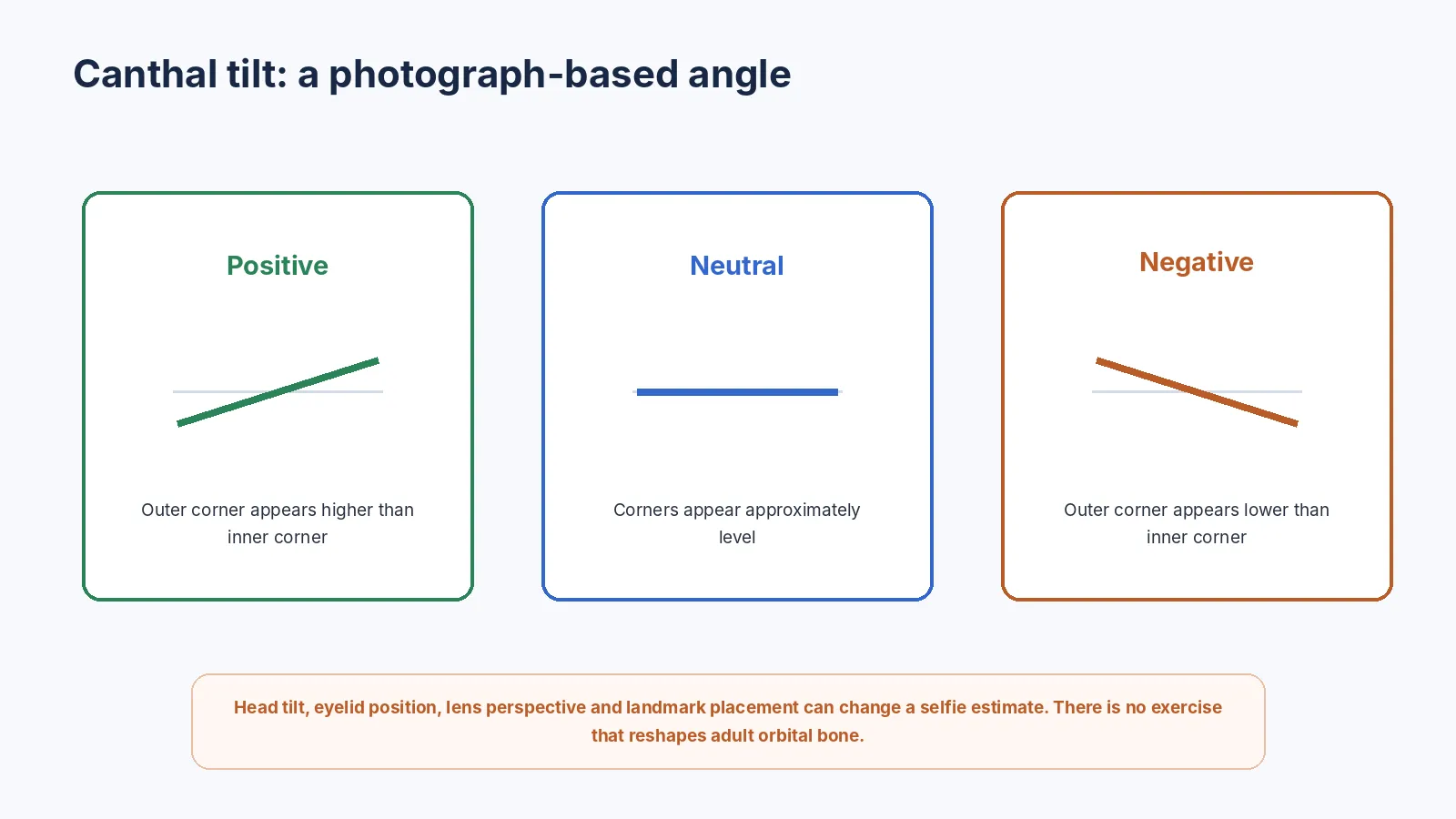
Canthal tilt is the apparent slope from the inner corner of the eye to the outer corner. If the outer corner appears higher, the tilt is commonly called positive. If the corners appear level, it is neutral. If the outer corner appears lower, it is negative. The angle is one anatomical and photographic feature, not a complete measure of attractiveness.
A selfie estimate can change with head tilt, lens perspective, eyelid position and landmark detection. Do not treat a few degrees as a diagnosis or universal beauty threshold.
Published 2026-08-06 · Last reviewed 2026-08-06
The anatomy behind the term
The medial canthus is the inner corner where the eyelids meet near the nose. The lateral canthus is the outer corner. Canthal tilt is usually estimated from a line connecting those visible points relative to horizontal or another facial reference line.
The visible eyelid opening and the skeletal orbit are related but not identical. Skin, eyelid tissues, expression and head position influence the photograph.
Positive, neutral and negative tilt
| Label | Visual description |
|---|---|
| Positive | The outer eye corner appears higher than the inner corner. |
| Neutral | The two corners appear approximately level. |
| Negative | The outer eye corner appears lower than the inner corner. |
These labels are descriptive. They are not medical grades, personality categories or proof that one person is more attractive than another.
How a tool estimates the angle
- Detect the face and eye region.
- Estimate inner- and outer-corner landmarks.
- Choose a horizontal or face-relative reference line.
- Calculate the slope or angle.
- Apply any site-defined score or label.
The final score is influenced by how the reference line is chosen. A tool that compares the eye line with the image edge can be especially sensitive to head tilt. A face-relative line may reduce some pose effects but still depends on accurate landmark placement.
What research can and cannot show
A 2007 experimental study found that manipulated female faces with accentuated medial canthal tilt were preferred in that study’s forced-choice task. The result is relevant evidence that eye inclination can influence judgments in a specific context.
It does not establish that one exact degree is ideal for everyone, that the effect applies equally to all populations and genders, or that canthal tilt outweighs the rest of the face. The images were manipulated, the task was constrained and attractiveness remains multidimensional.
Why your measured tilt may change
- Tilting the head changes the eye line relative to the image.
- Rotating the face alters the apparent positions of inner and outer corners.
- Squinting or raising the cheeks changes eyelid shape.
- Glasses, lashes, makeup, shadows or low resolution can confuse landmarks.
- Natural left-right differences may produce different angles for each eye.
Can you change canthal tilt naturally?
Adult orbital bone and the structural support of the eyelids are not remodeled by squinting routines, eyelid pulling or online “eye exercises.” Expression, styling, eyebrow shape, makeup and temporary swelling can change presentation, but they do not provide evidence of skeletal change.
When to seek eye care
A longstanding appearance difference without symptoms is not the same as a new eyelid change. Seek professional assessment for sudden drooping, double vision, pain, injury, visual change, new marked asymmetry or swelling. An online angle calculator cannot determine the cause.
How Omogle should score canthal tilt
The Methodology should define the exact landmarks, reference line, sign convention and weighting used. The result should be described as an image-based angle estimate. Avoid assigning personality traits, ethnic rankings or universal attractiveness claims.
| Acceptable | Not acceptable |
|---|---|
| The detected eye-corner line slopes upward in this image. | Positive tilt makes everyone attractive. |
| Head position may change the estimate. | This angle proves your orbital structure is defective. |
| It is one limited input in the formula. | You can permanently change it with exercises. |
| See an eye professional for symptoms. | The tool diagnoses eyelid or orbital disease. |
Frequently asked questions
What is positive canthal tilt?
Is neutral canthal tilt unattractive?
What is the ideal canthal tilt?
Can head tilt change the measurement?
Can eye exercises create positive tilt?
When should an eyelid change be checked?
References
- [1] Is medial canthal tilt a powerful cue for facial attractiveness? — Specific experimental study; present with its limited context rather than as universal law.
- [2] Subjectivity and complexity of facial attractiveness — Supports broader limits of single-feature conclusions.
- [3] Omogle Methodology — Product-specific landmarks and weighting source.