Gonial Angle Explained: Jaw Anatomy, Measurement, and the Myth of One Ideal
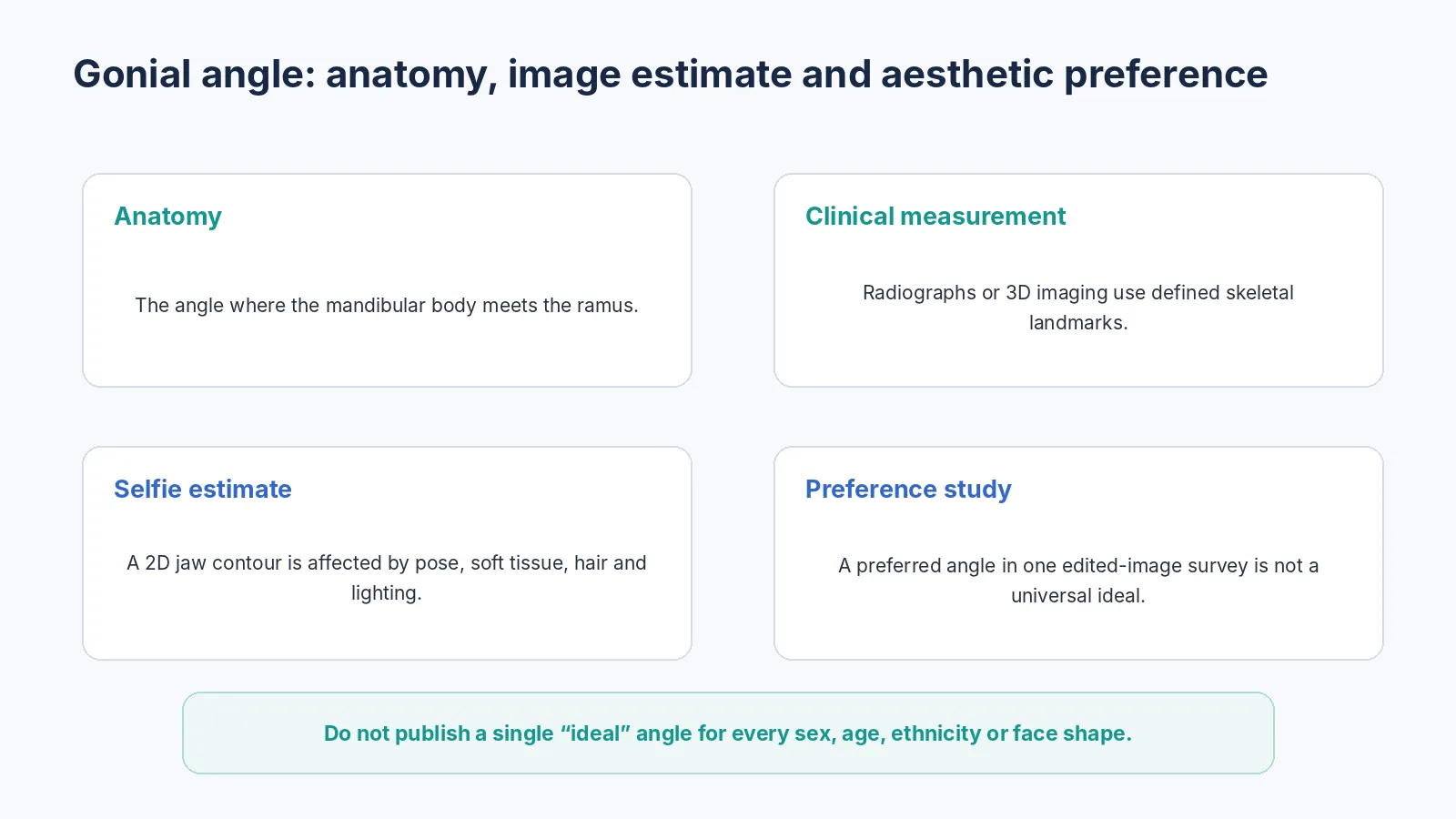
The gonial angle is the angle near the back-lower corner of the mandible, where the body of the lower jaw meets the upward ramus. It is used in dentistry, orthodontics, radiology, surgery and online appearance discussions. A clinical skeletal measurement is not the same as tracing the visible jawline in a selfie.
There is no single ideal gonial angle for every face. Reported preferences depend on the study images, view, population, sex category, surrounding proportions and survey design.
Published 2026-08-06 · Last reviewed 2026-08-06
Where is the gonial angle?
The anatomical angle lies around the junction between the horizontal mandibular body and the vertical ramus. Clinicians identify specific landmarks on radiographs or three-dimensional images. In a photograph, users often approximate the visible corner below the ear, but soft tissue and pose obscure the underlying bone.
How it is measured clinically
A cephalometric or panoramic measurement uses defined lines along the mandibular body and ramus. Values can differ by imaging technique, landmark definition and patient position. The measurement may be relevant to growth, dental relationships or surgical planning, but interpretation belongs in the clinical context.
Why a selfie angle is different
- Soft tissue adds volume around the jaw and neck.
- Facial hair can create a sharper or wider visual boundary.
- Head rotation changes the apparent angle.
- Camera height and distance alter the contour.
- Lighting can hide or emphasize the corner.
- A two-dimensional image cannot fully represent three-dimensional mandibular shape.
What preference studies show
An internet survey of male jaw images reported a preferred profile angle around 130 degrees together with other characteristics. A separate survey of female jaw images found preferences for different combinations of angle, width and vertical position. These studies describe responses to selected edited images; they do not establish a medical norm or universal target.
The surrounding chin, neck, cheek width, ramus length and facial proportions influence perception. Copying one angle while ignoring the rest of the face oversimplifies the research.
Why “ideal” charts conflict
Online charts often mix radiographic angles, soft-tissue profile angles and frontal-view contours. Some reverse the direction of measurement or cite a value from one group as though it applies to everyone. The same number may describe different geometry.
| Before citing an angle | Required detail |
|---|---|
| Landmarks | Which exact lines and points form the angle? |
| View | Profile, frontal, panoramic radiograph, cephalogram or 3D scan? |
| Population | Who was studied and how were images selected? |
| Outcome | Clinical norm, sample average or attractiveness preference? |
| Uncertainty | How much did raters disagree and how broad was the acceptable range? |
Can the gonial angle change?
Jaw growth occurs during development, and clinical treatment can alter dental or skeletal relationships in appropriate patients. Ordinary chewing, mewing or jaw trainers have not been shown to safely sculpt an adult mandible into a chosen angle.
Muscle tension, body composition, facial hair and head posture can change the visible jawline without changing the skeletal angle. That distinction should be explicit.
Jaw symptoms are not an aesthetic score
Pain, locking, limited opening, a new bite change or painful clicking may involve temporomandibular disorders and needs professional assessment. NIDCR advises conservative care and reducing habits such as clenching and excessive gum chewing; an appearance article should not prescribe heavy chewing to build a jaw.
How Omogle should describe the measurement
If Omogle estimates a jawline measure, publish the exact landmark definition and call it an image-based proxy. Do not claim that it equals a radiographic gonial angle, identify a medical abnormality or prescribe an ideal by gender.
Delete exact “ideal male” and “ideal female” claims unless the text clearly names the limited study, measurement view and population. Never use those values as treatment targets.
Frequently asked questions
What is a gonial angle?
What is the normal gonial angle?
What is the ideal jaw angle?
Can I measure it from a selfie?
Can mewing change the angle?
Should jaw pain be checked?
References
- [1] The ideal male jaw angle — An Internet survey — Context-specific preference survey, not a universal clinical standard.
- [2] Psychometric and Perceptometric Comparisons of the Perspectives of Orthodontists, Oral and Maxillofacial Surgeons, and Laypeople — Shows preference findings depend on viewpoint and participant group.
- [3] Facial asymmetry: a current review — Clinical context for normal variation and assessment.
- [4] TMD — NIDCR — Authoritative symptoms and conservative-care boundary.
- [5] Omogle Methodology — Product-specific definition if a jawline proxy is used.