Facial Harmony and the Golden Ratio: Useful Geometry, Unsupported Beauty Rules
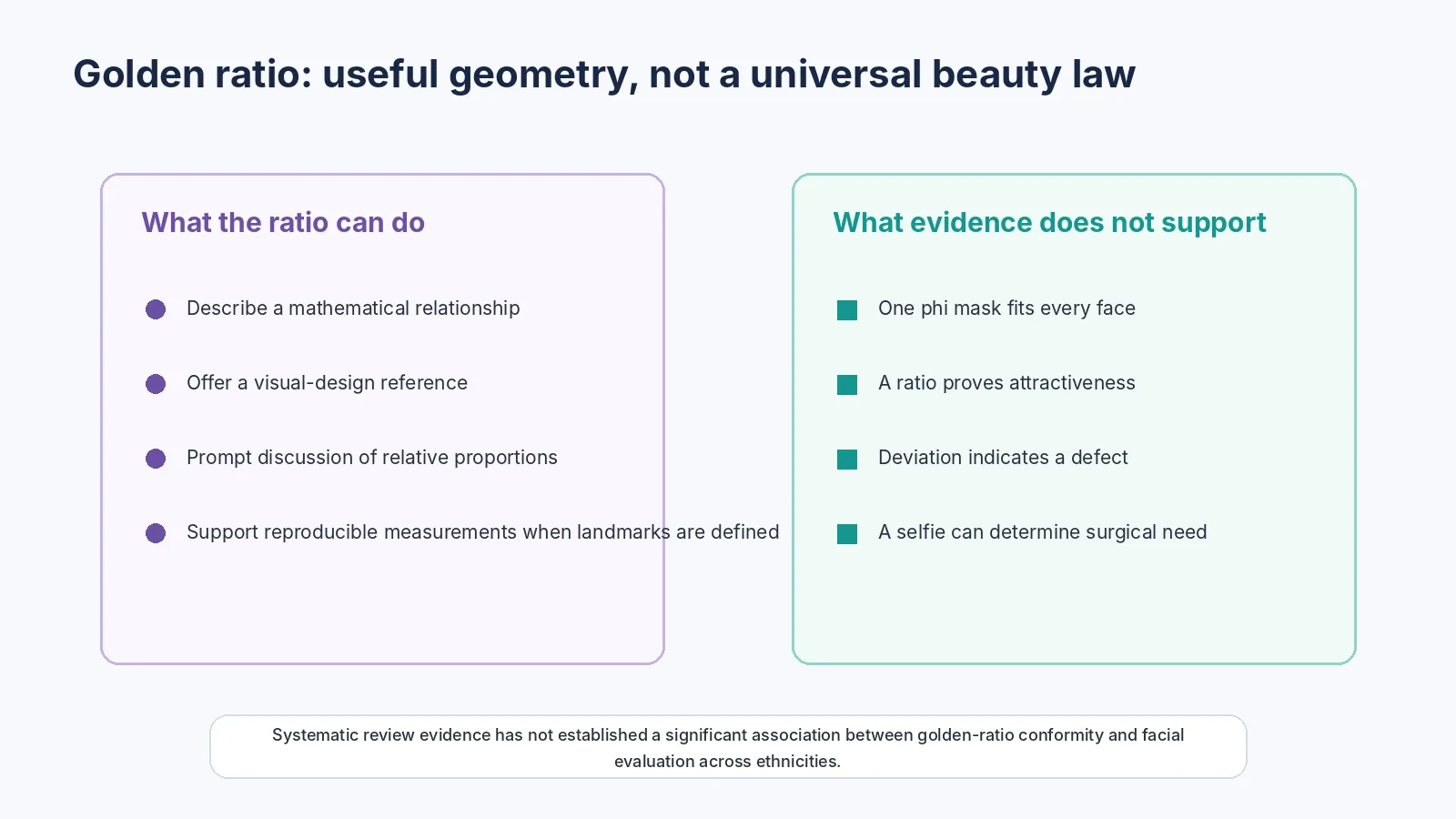
Facial harmony describes how features appear to relate to one another across the whole face. The golden ratio, approximately 1.618, is one mathematical relationship sometimes used in art, design and facial analysis. It can be calculated, but evidence does not show that closer conformity to one golden-ratio mask produces universally higher facial attractiveness.
Published 2026-08-06 · Last reviewed 2026-08-06
What is facial harmony?
Facial harmony is a broad aesthetic idea rather than one measurement. It may refer to relative feature size, spacing, balance between the upper and lower face, profile relationships, expression and how individual features fit the overall face.
Because harmony is holistic, two faces can have different measurements and both appear coherent. Isolating one ratio can miss interactions between features, soft tissue, expression and individual preference.
What is the golden ratio?
The golden ratio occurs when a whole quantity relates to its larger part in the same way that the larger part relates to the smaller part. It is commonly represented by the Greek letter phi and is approximately 1.618. The number is real mathematics; the claim that it defines every attractive face is a separate and much weaker proposition.
How golden-ratio face masks are used
A face mask may overlay lines and target points on a photograph. The software compares selected distances with ratios chosen by the designer. Different masks use different landmarks and can produce different conclusions from the same photograph.
- A ratio depends on exactly where each landmark is placed.
- A two-dimensional selfie is affected by camera perspective.
- Face shape, sex, age and ancestry vary naturally.
- Soft tissue and expression can change visible relationships.
- The designer decides which ratios matter and how deviations are scored.
What research says
A 2024 systematic review on golden proportion and facial evaluation reported no significant association between golden-ratio conformity and evaluation scores across the ethnicities examined. Another 2024 paper explicitly described the golden ratio as a myth in idealized human proportions and facial beauty, concluding that convincing evidence is lacking.
This does not mean proportions are irrelevant. It means that phi should not be elevated above all other measurements or used as a universal diagnostic and beauty threshold.
Why a single universal mask fails
Population variation
Average feature relationships vary among populations. A mask derived from one narrow set of faces may penalize normal variation elsewhere.
Sex and age variation
Facial growth, soft tissue and skeletal relationships change across age and may differ on average between groups. One fixed target cannot represent every face.
Individual preference
People share some tendencies but also differ meaningfully in preferred faces. A formula cannot replace the social and subjective experience of attraction.
Measurement error
Slight head rotation or a close camera can change apparent width and height ratios. A precise decimal result can therefore be precise about a distorted photograph.
How Omogle should discuss harmony
Omogle can state which landmark-derived relationships its current formula calculates and how those measurements are normalized. It should call them internal geometry measures, not universal ideals.
| Responsible wording | Avoid |
|---|---|
| The formula compares selected distances and proportional relationships. | The golden ratio proves whether a face is beautiful. |
| The result is specific to this photo and method. | Your face is X% perfect. |
| Ratios are one limited part of facial analysis. | Every attractive face follows phi. |
| Different faces can be harmonious in different ways. | Deviation from the mask is a defect. |
Can facial harmony be improved?
Presentation can change through lighting, camera position, hair, grooming, expression and styling. Health or functional concerns involving teeth, bite, breathing, injury or skin should be evaluated by an appropriate professional. An online ratio does not determine whether treatment is needed.
Do not recommend surgery, orthodontics, fillers or dieting because a selfie differs from a golden-ratio overlay.
A better way to read proportion results
- Check whether the photograph is centered and front-facing.
- Confirm that visible landmark points align with the face.
- Read which exact distances are included.
- Look for evidence supporting any target values.
- Interpret the output as a visual description, not a diagnosis or rank.
Frequently asked questions
What is the golden ratio for a face?
Does a beautiful face have to follow phi?
Can an app measure facial harmony?
Why do different golden-ratio apps disagree?
Can I change facial proportions with exercises?
Does Omogle use the golden ratio?
References
- [1] Assessment of the golden proportion in natural facial esthetics: A systematic review — Systematic review reporting no significant association across evaluated ethnicities.
- [2] The golden ratio — dispelling the myth — Review concluding that convincing evidence linking phi with ideal human proportions or facial beauty is lacking.
- [3] Subjectivity and complexity of facial attractiveness — Evidence of meaningful variation in individual preferences.
- [4] Omogle Methodology — The only source for which proportional calculations Omogle actually uses.