What Is a Good PSL Score? How to Read the Number Responsibly
A “good” PSL score is not a scientifically fixed number. PSL is an informal online appearance-rating framework, and different communities and tools use different ranges, labels and formulas. On Omogle, a higher number means that one photograph aligned more closely with the current scoring formula. It does not prove that the person belongs to a specific population percentile or that everyone will find them attractive.
Published 2026-08-06 · Last reviewed 2026-08-06
Why there is no universal good PSL score
The PSL scale developed informally in online appearance communities. It was not created by a medical organization, psychometrics body or international standards group. Historical descriptions often use an approximately 1–8 range, while many newer face-rating tools use 1–10. Even when two websites display the same number, their underlying methods may be unrelated.
A human rater may rely on community taste. A landmark tool may calculate angles and distances. A neural network may predict ratings found in a training dataset. Because those methods answer different questions, a score cannot be moved from one system to another as though it were a measurement in centimeters.
What the number means on Omogle
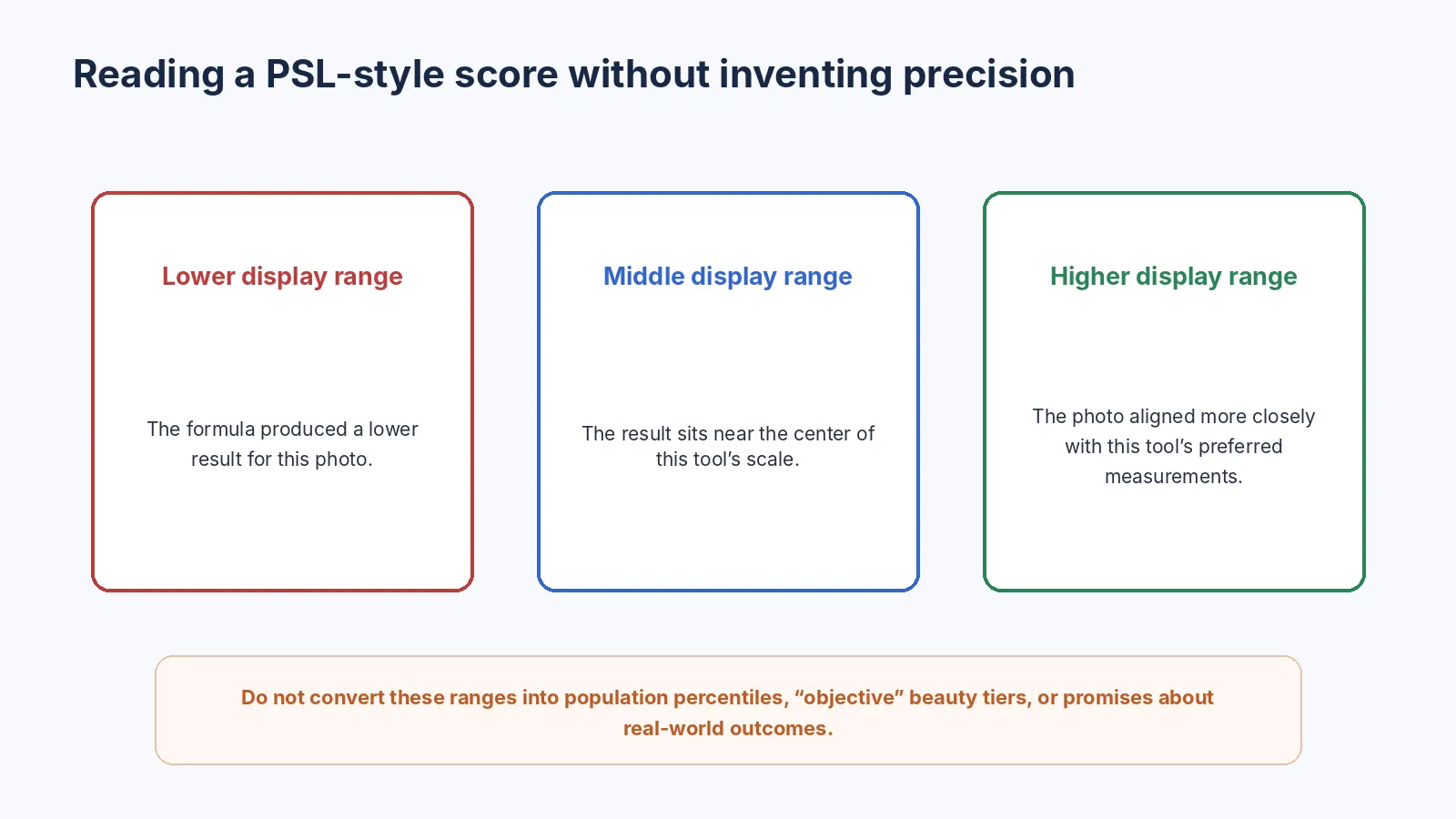
Omogle uses a PSL-style 1–10 presentation for entertainment. Five is the midpoint of that displayed range. It should not be described as a proven population average. The score depends on the detected landmarks, the site-defined weighting and the photograph used.
| Display area | Responsible interpretation |
|---|---|
| Lower range | The selected photograph produced a lower result under Omogle’s current formula. |
| Middle range | The result sits near the center of Omogle’s displayed scale. |
| Higher range | The photograph aligned more closely with measurements rewarded by the current formula. |
None of those descriptions tells us how many people would receive the same result. Omogle has not published a representative population study that would support percentile labels, a normal distribution or separate averages by gender, age or ethnicity.
Why exact percentile charts are unreliable
A valid percentile requires a clearly defined reference population, representative sampling, a stable scoring method and enough participants to estimate the distribution. A chart cannot become scientific simply because it contains precise percentages.
For example, stating that a score of 7 places someone in the top 5% would require Omogle to score a representative sample using the same version of the model and formula, publish the method, document exclusions and report uncertainty. Without that evidence, the percentage is invented precision.
Remove all current claims that assign Omogle scores to “top 15%,” “top 5%,” “model tier,” a statistical bell curve or guaranteed social advantages.
Why the same person can receive different scores
The tool evaluates an image rather than a permanent three-dimensional face. Head rotation changes apparent widths. A close phone camera exaggerates central features. Side lighting can sharpen or hide the jaw contour. Smiling changes the cheeks, eyes and mouth landmarks. Filters can modify nearly every measurement.
- Use the exact same image to test software repeatability.
- Use several controlled photographs to test sensitivity to pose and lighting.
- Do not treat a small change between unrelated selfies as physical improvement.
- Recheck results after a site update because the model or weighting may have changed.
Does a higher PSL score mean more attractive?
It means that the input aligned more closely with the preferences encoded in that scoring system. Human attractiveness remains contextual and subjective. Research can identify patterns shared by groups, but individual preferences still differ, and limited datasets do not define a universal standard.
The original SCUT-FBP benchmark, for instance, contained 500 Asian female subjects with human ratings. It was useful for comparing computational methods within that research setting, but it cannot define an objective global scale for every person, age, ethnicity and photograph.
A healthier way to use the result
Use a score as a prompt to understand image conditions and model behavior, not as a verdict. Ask whether the face was detected correctly, whether landmarks look plausible and whether the photograph was suitable. A person’s appearance in conversation, movement and varied lighting is much richer than a still-image formula.
- Read the score together with the methodology and limitations.
- Focus on large, repeatable differences rather than tiny fluctuations.
- Compare only results from the same tool version and controlled photo setup.
- Avoid public rankings or using someone else’s photograph without consent.
- Stop testing if the score begins to affect mood, confidence or daily decisions.
When score checking stops being useful
Repeatedly taking dozens of photographs, seeking reassurance, avoiding social situations or spending hours comparing individual features can be signs that appearance checking has become harmful. The NHS describes frequent comparison, mirror checking or mirror avoidance and intense worry about perceived flaws as possible features of body dysmorphic disorder. A face-rating result should never be used to reinforce that cycle.
Frequently asked questions
Is 5 a good PSL score?
Is 6 above average?
Is 7 a top-five-percent score?
Can two PSL tools be compared?
Can my score improve without my face changing?
Should I use the score to decide on cosmetic treatment?
References
- [1] SCUT-FBP: A Benchmark Dataset for Facial Beauty Perception — Use to explain the narrow scope of a specific attractiveness dataset, not to validate Omogle.
- [2] Subjectivity and complexity of facial attractiveness — Supports the point that individual facial preferences differ.
- [3] Body dysmorphic disorder — NHS — Authoritative warning signs for compulsive appearance concern.
- [4] Omogle Methodology — Product-specific scoring and limitation source.
- [5] PSL scale history reporting — GQ — Use for cultural history, not medical or scientific claims.