AI Face Rating Accuracy: What the Score Can and Cannot Tell You
AI face rating accuracy is not one single number. A tool may correctly find a face and place landmarks while still producing a final attractiveness score that is subjective, photo-dependent or unvalidated.
The honest answer is that facial AI can measure selected patterns in an image, but a consumer score does not become an objective measurement of beauty simply because a neural network or geometric formula produced it.
Published 2026-08-06 · Last reviewed 2026-08-06
The key is to separate five layers: face detection, landmark placement, repeatability, agreement with a defined group of human raters, and validity as a measure of attractiveness.
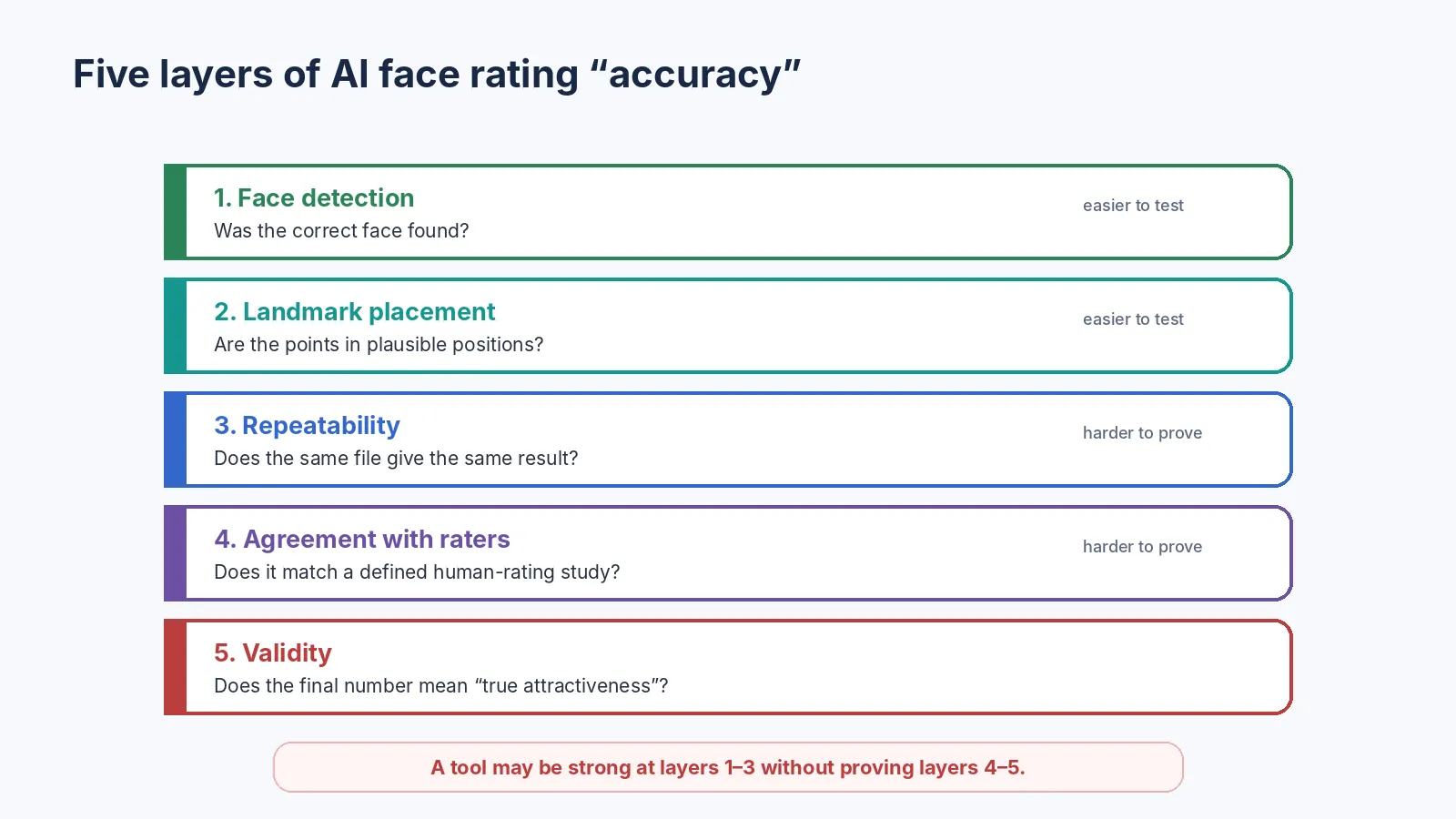
1. Face detection accuracy
The first question is whether the system located the correct face. A failure may involve no face detected, the wrong face selected in a group photo, a background pattern treated as a face, or part of the real face excluded from the detection box.
This layer is relatively easy to inspect when the interface shows the detection box. Good face detection is necessary, but it says nothing about whether the final beauty score is meaningful.
2. Facial landmark accuracy
After detection, a landmark model estimates points around visible facial regions. A 68-point model commonly maps parts of the jaw, eyebrows, eyes, nose and mouth. The points are estimates in a two-dimensional image.
Landmark errors can occur because of blur, rotation, shadows, hair, glasses, facial expression or limitations of the model. If a point is misplaced, every distance or angle derived from it may also be wrong.
A landmark overlay is more informative than a confident-looking score. It allows the user or developer to check whether the points are in plausible locations.
3. Repeatability and consistency
Repeatability asks whether the same input under the same software version gives the same result. It is testable: run the exact same file several times.
Consistency is useful, but it is not proof of truth. A formula can return the same number every time and still rely on arbitrary targets or weights. Conversely, different photographs of the same person can produce different results even when the system is deterministic because the pixels are different.
| Question | What it tests | What it does not prove |
|---|---|---|
| Same file, repeated | Determinism and implementation stability | That the attractiveness definition is valid |
| Same crop, different resolution | Sensitivity to resizing and compression | That the landmarks match anatomy |
| Different controlled photos | Sensitivity to angle, expression and light | That score changes represent physical change |
| Different tools | Difference between models and formulas | Which tool has the “true” score |
4. Agreement with human ratings
Some research models are evaluated by comparing predictions with average ratings collected from participants. A correlation can show that a model reproduces patterns in a particular dataset.
For example, research using the SCUT-FBP dataset reported correlations between model predictions and human ratings. Those results belong to specific models, images, participant labels and evaluation procedures. They must not be rewritten as “all AI face raters are 80% accurate.” A correlation coefficient is not an accuracy percentage.
A consumer tool cannot borrow the performance result of an unrelated paper. If Omogle wants to publish a numerical accuracy statement, it needs a documented study of the exact Omogle implementation, a defined target, a sufficiently diverse test set, preregistered evaluation criteria and transparent reporting.
5. Validity as a measure of attractiveness
Validity is the hardest layer. It asks whether the final score represents the concept users think it represents.
Attractiveness is not a physical unit with a universal reference instrument. Human judgments vary with the observer, culture, context, expression, familiarity and many nonvisual qualities. Even a model that matches the average ratings in one dataset does not establish a timeless ranking of all people.
What AI face rating can do reasonably well
- Locate a suitable face in a clear image.
- Estimate selected landmark positions.
- Calculate distances and angles from those detected points.
- Apply a documented formula consistently to the same file.
- Demonstrate how image conditions affect a computer-vision output.
What the score cannot establish
- How every person will perceive you.
- A global population percentile.
- An objective “good” or “bad” appearance category.
- Whether a cosmetic or medical intervention is appropriate.
- Whether a small score difference represents a real facial change.
- Your personality, confidence, social presence or worth.
Why photographs change the result
Camera distance and lens perspective
A close phone camera can exaggerate the central face relative to the sides. Moving the camera farther away and cropping later often changes apparent proportions.
Head rotation and tilt
Even a small turn changes apparent widths and left-right relationships. A two-dimensional model cannot perfectly recover three-dimensional anatomy from one photograph.
Expression
Smiling changes mouth width, cheek position, eye opening and the lower-face contour. A tense jaw or raised eyebrows also moves landmarks.
Lighting and image quality
Shadows can obscure the jaw or nose boundary. Blur and compression can reduce landmark precision. NIST evaluations of other facial-AI tasks show that image quality and demographic conditions can materially affect algorithm performance. These findings do not validate or invalidate an attractiveness score directly, but they demonstrate why facial AI requires careful testing rather than broad assumptions.
Filters and editing
Beauty modes may alter feature size, skin appearance and face contour. The resulting score describes the edited image, not an unmodified baseline.
Can AI face rating be biased?
Bias can enter at several stages:
- the images used to train the detector or prediction model;
- the demographic composition of human raters;
- the developer’s choice of “ideal” measurements;
- uneven image quality across users;
- a formula that assumes one set of preferences applies to everyone;
- testing that is too small or homogeneous to reveal failures.
Face recognition and face attractiveness prediction are different tasks, so evidence from one should not be presented as direct performance evidence for the other. NIST’s large-scale face-recognition testing is relevant as a general warning that facial algorithms can have demographic differentials and that model-specific evaluation matters.
How accurate is Omogle?
The current defensible description is narrow and transparent: Omogle uses browser-side landmark detection and applies a site-defined scoring formula. It can display measurements and a repeatable result when the same image is processed under the same version, but Omogle has not published an independent, representative study proving that the final score is an objective measure of attractiveness.
The page must remove claims that Omogle compares users with “thousands or millions of human-rated faces” unless that is genuinely part of the implementation. It must also remove unsupported claims such as a universal 0.5–0.7 correlation, exact ideal angle ranges and fixed score differences between tools.
A practical consistency test
- Run the exact same image three times. Record whether the score and sub-scores are identical.
- Resize the same crop to several resolutions. Check whether the result changes substantially.
- Use a controlled set of front-facing photographs with the same camera and light, changing only one factor at a time.
- Inspect landmark placement when a visual overlay is available.
- Repeat the test after any model or scoring update and record the version.
This process evaluates implementation stability and photo sensitivity. It does not validate attractiveness as an objective concept.
How should you interpret your result?
Small differences are especially easy to overinterpret. Unless Omogle establishes a measurement error range and a validated test protocol, a change from 5.4 to 5.7 should not be described as meaningful progress.
Frequently asked questions
How accurate are AI face rating tools?
Is a high correlation the same as high accuracy?
Why does my score change between photos?
Are human ratings more accurate?
Can Omogle track physical progress?
Can facial AI be biased?
References
- [1] Xie et al., SCUT-FBP benchmark — Example of model evaluation on a defined human-rated dataset.
- [2] Kagian et al., A machine learning predictor of facial attractiveness — Early research on predicting mean human ratings; not evidence for Omogle.
- [3] Oh et al., Subjectivity and complexity of facial attractiveness — Individual variation in facial preference.
- [4] NIST Face Recognition Vendor Test: Demographic Effects — General evidence for algorithm-specific and demographic evaluation.
- [5] Omogle Methodology — Product-specific technical source of truth.