AI Face Rating: Can It Tell If I Am Attractive?
An AI face rating tool can analyze a photograph and apply a scoring system to visible features. It cannot give a universal yes-or-no answer to “Am I attractive?” because attraction is not a single physical measurement and a still image excludes much of what people respond to in real life.
The useful question is not simply whether the number is high. It is: What did this particular tool measure, how was the score created, and how much did the photograph influence it?
Published 2026-08-06 · Last reviewed 2026-08-06
What is AI face rating?
AI face rating is a broad category of tools that turn information from a face photograph into a score, tier or feature report. There is no industry-wide standard. Two products can both use the phrase “AI attractiveness score” while relying on very different technologies and assumptions.
Some systems are primarily geometric. Others are prediction models trained on photographs that people previously rated. Some send images to a general-purpose multimodal model. A polished score card does not reveal which approach was used, so transparent methodology matters.
Four common types of AI face rater
| Method | How it works | Main limitation |
|---|---|---|
| Landmark formula | Detects points and applies developer-defined ratios, angles and weights | The scoring preferences are chosen by the developer |
| Trained prediction model | Learns patterns from a human-rated image dataset | The score reflects the dataset and its raters |
| Hybrid system | Combines geometric features with learned predictions | Harder to audit; both formula and dataset assumptions matter |
| Generative AI report | A multimodal model describes or rates an image | Output may vary and methodology may be opaque |
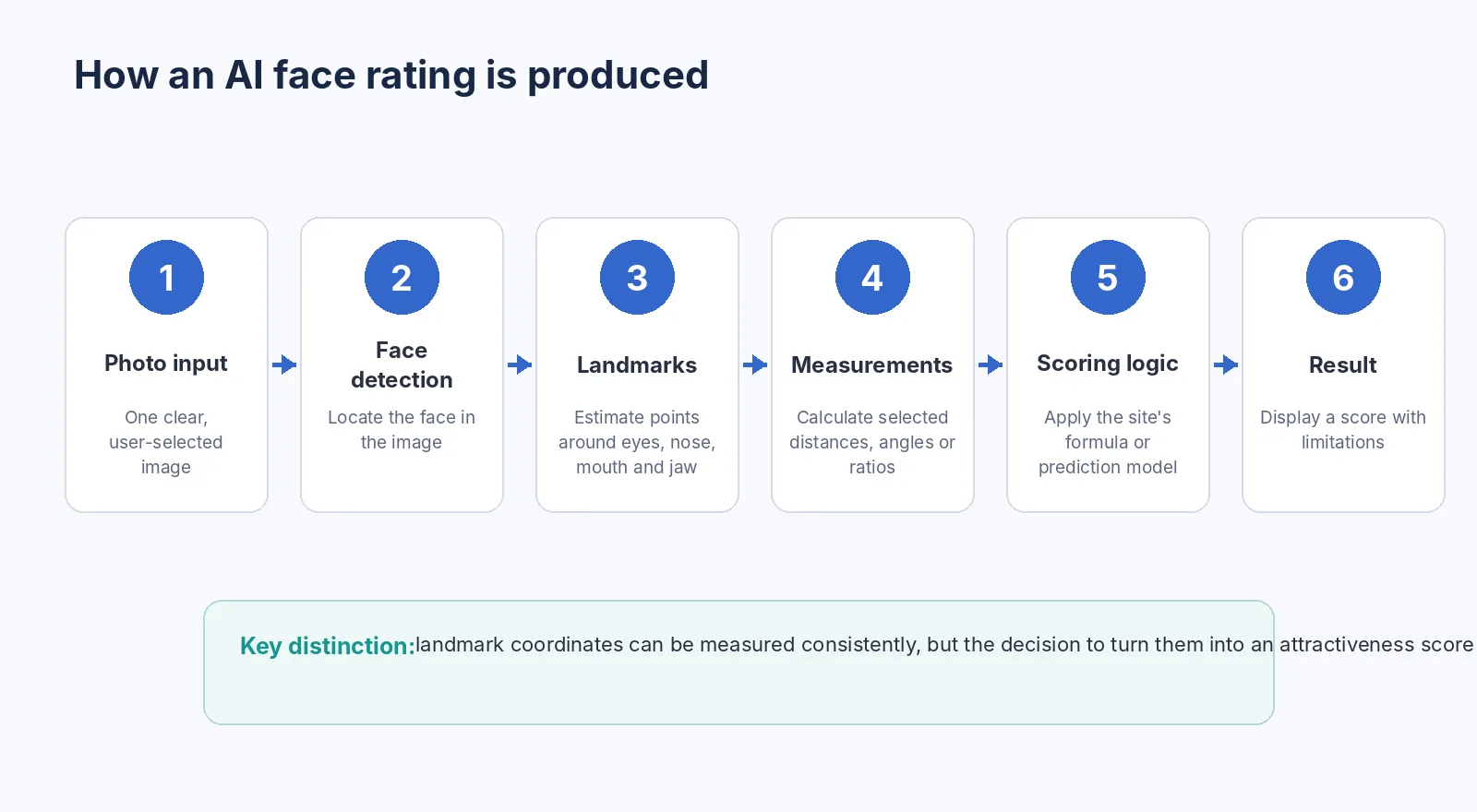
How does AI face rating work?
1. The user provides a photograph
The image may be selected from the device, captured with a camera, pasted into the page or transmitted to a server. Processing location is a privacy question; it does not by itself prove that the score is valid.
2. The system detects a face
The software locates the face and may reject an image when no suitable face is visible, several faces are present, or important features are obscured.
3. The system estimates landmarks or visual features
A landmark model estimates coordinates around facial regions. A deep network may instead produce internal visual features that are not directly interpretable. In both cases, this step extracts information from the image; it does not yet establish attractiveness.
4. Measurements or predictions are produced
A geometric system calculates distances, angles and relative positions. A trained model predicts a value based on patterns learned from its dataset. Different methods can produce different outputs from the same photograph.
5. The result is normalized and displayed
The application converts the output into a familiar range such as 1–10, a percentage or a tier. The display range is a product choice. A decimal value can create an impression of scientific precision even when the underlying target remains subjective.
What can a face rater measure?
With a suitable photograph, a tool may estimate:
- visible landmark positions;
- selected distances between landmarks;
- left-right differences in the image;
- apparent head orientation;
- relative positions of the eyes, nose, mouth and jaw;
- specific angles defined by the application.
These measurements describe the image. They are not automatically exact measurements of three-dimensional anatomy. Perspective, lens choice, head rotation, expression and lighting can change apparent feature relationships.
What does an AI score leave out?
Real-world attraction develops from more than static facial structure. A still photograph cannot capture:
- voice and communication style;
- movement and body language;
- humor, warmth and kindness;
- confidence and comfort in a situation;
- style, grooming and context over time;
- shared values and personal compatibility;
- how expression changes during interaction.
Research on facial preference includes both recurring tendencies and substantial individual variation. A model can imitate the average ratings in one dataset without discovering a universal law of beauty.
Does symmetry equal attractiveness?
No. Symmetry is frequently discussed in attractiveness research and face-rating tools, but it is only one possible factor. Natural faces are not perfectly symmetrical, and the importance of symmetry varies with the stimulus, method and observer. A symmetry score should not be used as a complete attractiveness score.
The same caution applies to the golden ratio, canthal tilt, jaw angles and facial thirds. Software may calculate these concepts, but no single measurement determines how a person is perceived.
How training data shapes a score
A prediction model learns from the examples and labels used during training. If the training photographs represent a narrow population, studio style or age range, the model may not generalize well to ordinary users.
The original SCUT-FBP benchmark, for example, was built from 500 Asian female subjects with human attractiveness ratings. It supported useful research, but its composition also demonstrates why a result from one dataset should not be advertised as a universal human standard.
A reported correlation from an academic model does not transfer automatically to another consumer tool. Omogle should cite its own validation if it ever publishes a numerical accuracy claim.
Why do face-rating tools disagree?
- They use different face detectors or landmark models.
- They include different features.
- They assign different weights.
- They were trained on different images and raters.
- They normalize outputs differently.
- One analyzes locally while another sends the image to a remote model.
- Some outputs may include randomness or generative variation.
A disagreement does not mean one service has discovered the “real” score. It means the services are implementing different definitions.
Why does your score change between photos?
An AI face rater evaluates the photograph it receives. Small changes can alter visible geometry and model confidence:
- A close camera can exaggerate the central face.
- A slight head turn changes apparent symmetry and widths.
- Smiling changes the eye opening, cheek position and mouth shape.
- Side lighting changes visible contours.
- Blur and compression reduce landmark precision.
- Filters may reshape eyes, nose, skin and jaw.
For a controlled comparison, keep the same camera, distance, head position, lighting and expression. Do not treat a small difference between unrelated selfies as evidence that your appearance changed.
How Omogle approaches AI face rating
Omogle uses browser-side facial landmark detection and a site-defined scoring process to create a PSL-style entertainment reference. It should be described as a transparent image-geometry experience, not a scientifically validated beauty judge.
The current product description states that the selected photograph remains in the browser for the core analysis flow. The score is photo-dependent, and the website has not published a representative population benchmark or an objective-attractiveness study for its formula.
How to use an AI face rating responsibly
- Read the methodology before trusting the number.
- Use a clear, unfiltered photograph.
- Treat the result as one formula applied to one image.
- Do not compare scores from incompatible tools as if they used the same scale.
- Do not use a score to decide on medical or cosmetic treatment.
- Do not analyze or publicly rank another person without permission.
- Stop if repeated testing makes you anxious or preoccupied.
A score is most useful as a demonstration of how computer vision responds to an image. It is least useful when treated as a permanent identity label.
Frequently asked questions
Can AI accurately tell whether I am attractive?
Why did two tools give me different scores?
Is facial symmetry objective?
Can a low score be caused by the photo?
Can I use the score to track progress?
Is Omogle an objective beauty test?
References
- [1] face-api.js repository — Official documentation for browser-side face detection and landmarks.
- [2] Xie et al., SCUT-FBP: A Benchmark Dataset for Facial Beauty Perception — Example of a specific human-rated attractiveness dataset; not a universal standard.
- [3] Oh et al., Subjectivity and complexity of facial attractiveness — Evidence of individual differences in facial preference.
- [4] Little et al., Facial attractiveness: evolutionary based research — Review of factors and individual differences in face preference.
- [5] Omogle Methodology — Product-specific source of truth.