What Is Omogle? How the Private AI Face Rating Tool Works
Omogle is a free, browser-based face-analysis tool. You choose a photograph, the page detects visible facial landmarks, and Omogle applies its current scoring formula to produce a PSL-style entertainment result. It is a private, single-user experience rather than a live appearance competition.
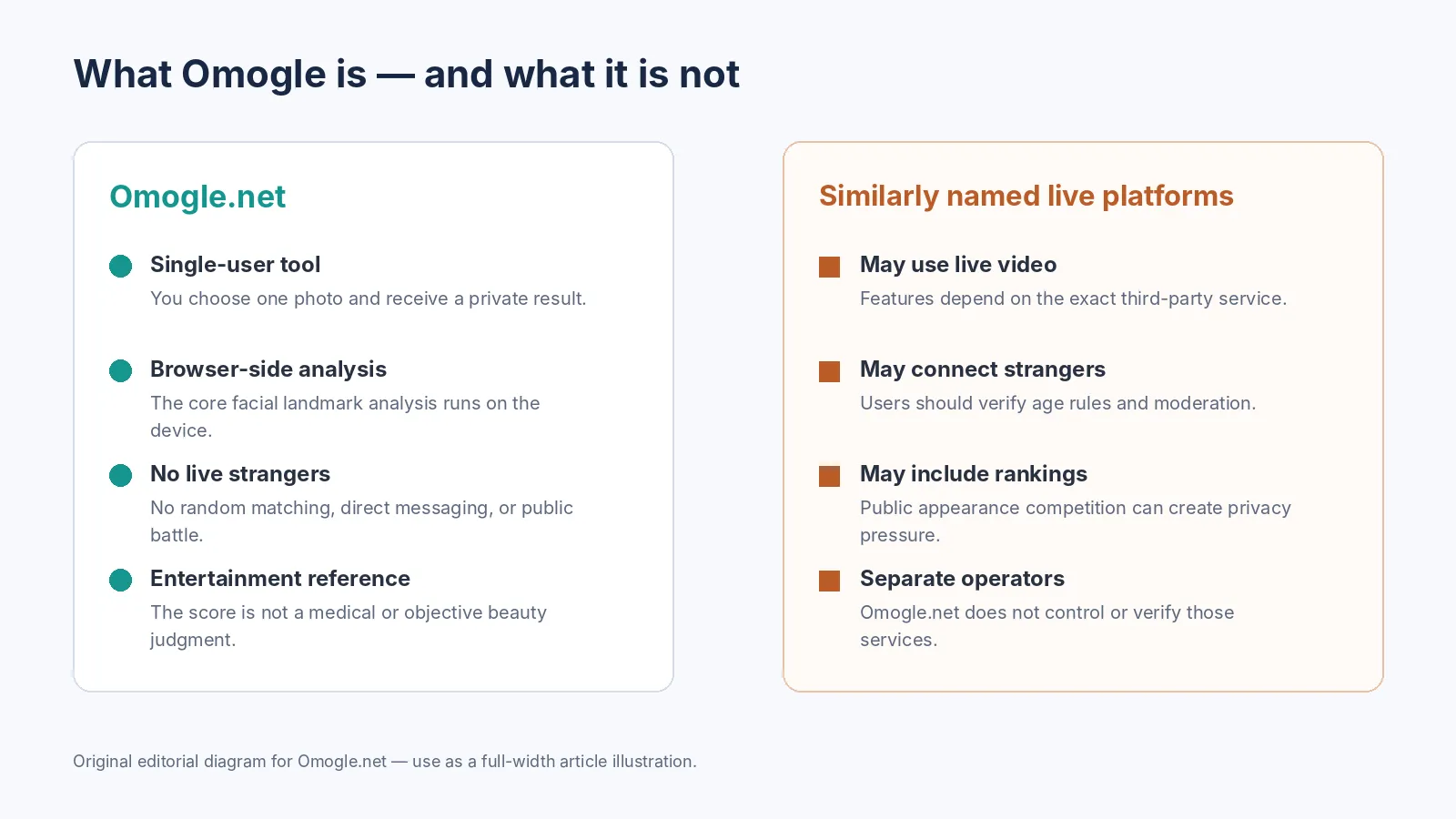
The name can cause confusion. People who type “Omogle” may originally be searching for similar spellings such as Omoggle or Ommogle, which can be associated with separate live 1v1 services. Omogle.net is an independent website. It does not run a random video-chat platform, connect users with strangers, or operate a public appearance leaderboard.
Published 2026-08-06 · Last reviewed 2026-08-06
What does Omogle do?
The core experience has four stages:
- You select a photograph containing one visible face.
- Browser-side computer vision estimates facial landmark positions.
- Omogle calculates selected geometric relationships from those landmarks.
- The page displays an overall result and feature-oriented sub-scores.
The exact result depends on the current implementation. The public Methodology page should remain the source of truth for the active model, the measurements that are actually calculated, and the current scoring weights. Marketing copy must never claim that the tool measures a feature that is absent from the code.
How does the face analysis work?
A facial landmark model does not begin by deciding whether a person is attractive. It begins by locating a face and estimating points around visible features such as the eyes, eyebrows, nose, mouth and jaw. Libraries such as face-api.js support browser-based face detection and 68-point landmark estimation. Those points are image coordinates, not beauty judgments.
Omogle then applies its own formula to measurements derived from the detected points. A measurement might describe a left-right difference, an eye-corner angle, the apparent jaw contour, or a proportional relationship between selected features. The scoring stage is a separate design layer: the developer chooses which measurements matter, how they are normalized, and how much weight each one receives.
A computer can calculate an angle consistently. The decision to reward one angle more than another is still a human design choice encoded in the formula.
What does the Omogle score mean?
Omogle presents a 1–10 result inspired by PSL terminology used in online appearance communities. PSL does not have an official standards organization, a representative population database, or one universally accepted formula. Different communities and applications use different ranges, tier names and assumptions.
For Omogle, the score should be described as an internal entertainment display. The middle of a 1–10 display is not automatically the measured average of the world population. A score should not be converted into claims such as “top 5%,” “below average in real life,” or “objectively attractive” unless Omogle conducts and publishes a suitable validation study — which it has not currently done.
What Omogle can measure from a photograph
When landmark detection succeeds, the application can derive information from the visible geometry in the image. Depending on the current formula, that may include selected left-right differences, relative feature positions, apparent jawline geometry, eye-corner angles, and proportional relationships.
These are measurements of a two-dimensional image. They are not perfect measurements of three-dimensional anatomy. Camera distance, focal length, head rotation, expression, shadows and partial obstruction can all change the apparent geometry.
What Omogle cannot tell you
- How every other person will perceive you.
- Your attractiveness across cultures, situations and personal preferences.
- Your personality, warmth, humor, confidence, voice or body language.
- Whether a facial feature is medically healthy or abnormal.
- Whether you should pursue cosmetic, dental or medical treatment.
- Whether a score change represents a physical change.
- Your value, relationship prospects, employability or social status.
A still photograph removes many of the qualities that shape attraction in real interaction. Research on facial preference finds both shared tendencies and meaningful individual differences. A face-rating result should therefore remain a low-stakes description of one image, not a verdict about the person in it.
Does Omogle upload your photo?
According to the current Omogle Privacy Policy, the selected photograph and the resulting facial measurements are processed in browser memory for the core analysis flow and are not sent to Omogle’s servers or a separate face-analysis provider. This is a meaningful difference from a service that sends a face image to a remote API.
Local face analysis does not mean that the website makes no network requests. The page still has to load HTML, scripts, model files, fonts and other resources. Hosting, security, analytics, consent and advertising providers may process ordinary website data such as IP address, browser details, cookies, referrer and visit time. The selected face image is a different category of data from those routine web requests.
The privacy wording on this page must always match observable network behavior and the current Privacy Policy. If Omogle later adds cloud analysis, account history, server-generated result cards or another feature that transmits the image, this article must be updated before that feature goes live.
Omogle vs Omoggle and Ommogle
Similar names do not guarantee that websites offer the same service. Visitors should confirm the exact domain before granting camera access, uploading a photograph or sharing personal information.
| Feature | Omogle.net | Similarly named live service |
|---|---|---|
| Core experience | Single-user analysis of a selected photograph | May involve live video or real-time interaction |
| Stranger matching | No | May be present; verify on the exact service |
| Public competition | No public leaderboard in the core Omogle flow | May include ranking, voting or appearance battles |
| Photo processing | Core analysis described as browser-side | Depends on the provider’s current policy and implementation |
| Operator | Omogle.net | Separate third-party operator |
Omogle.net cannot confirm another provider’s current age controls, moderation, storage, recording behavior or privacy practices. Users should read the other service’s official information rather than inferring safety from a similar spelling.
Why can the same person receive different results?
Omogle analyzes the pixels in a photograph, not a permanent facial identity. Results may change because of:
- camera angle and head rotation;
- distance from the lens and perspective distortion;
- facial expression;
- uneven lighting and shadows;
- image resolution, blur or compression;
- hair, glasses or accessories covering landmarks;
- beauty filters, portrait effects or retouching;
- changes to the model or scoring formula.
For a more repeatable result, use one clear front-facing image, keep the camera near eye level, use soft even lighting and avoid filters. The strongest technical repeatability check is to run the exact same file again. Comparing different selfies mostly compares different photography conditions.
Who is Omogle for?
Omogle is intended for users who are curious about browser-based face analysis, facial landmark geometry, PSL terminology and private alternatives to public appearance-rating experiences. It should be used for entertainment and education — not repeated reassurance seeking.
If checking scores increases anxiety, encourages harsh comparison, or makes you focus on small perceived flaws, stop using the tool. More tests rarely resolve appearance-related distress. Speaking with someone you trust or a qualified professional is more constructive than searching for a preferred score.
Frequently asked questions
Is Omogle free?
Is Omogle the same as Omoggle?
Does Omogle use a live camera?
Is the score scientifically accurate?
Does Omogle store face photos?
What does PSL mean on Omogle?
References
- [1] Omogle Privacy Policy — Source of truth for current photo and website-data handling.
- [2] Omogle Methodology — Source of truth for active models, measurements and limitations.
- [3] face-api.js repository — Official library documentation for browser-side face detection and landmarks.
- [4] Oh et al., Subjectivity and complexity of facial attractiveness — Research showing individual variation in facial preference.
- [5] NIST Face Recognition Technology Evaluation — Broader evidence that facial AI performance depends on image and algorithm conditions; not validation of attractiveness scores.